

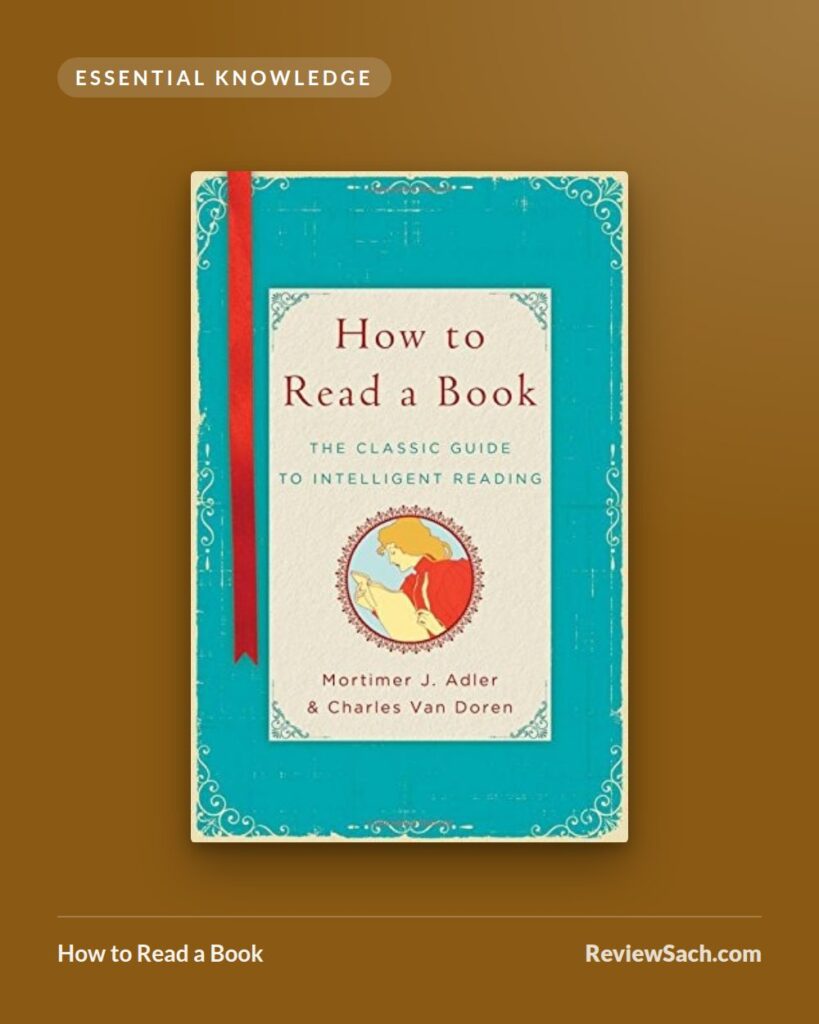
Author: Mortimer J. Adler and Charles Van Doren · Published: 1940 · Genre: Education, Reading
How to Read a Book teaches you to read for understanding, not just to collect information, through a step-by-step system for working through hard books. Its biggest strength is that the method genuinely works: follow its questions and you will get far more out of difficult nonfiction. Its biggest weakness is the delivery, which is long, dry and prescriptive, with a reading list and cultural assumptions that show their mid-century origins. It’s worth reading for students, self-learners and anyone who wants to take on serious books.
The core ideas
Adler published the original in 1940. The version most people read today is the thoroughly revised 1972 edition, written with Charles Van Doren.
- Reading is active. A good reader asks questions while reading and tries to answer them. The four basic ones: what the book is about as a whole, what it says in detail and how, whether it is true in whole or in part, and why it matters.
- Four levels of reading. Elementary reading is basic literacy. Inspectional reading means systematic skimming (title, preface, table of contents, index, a few key passages) followed by a quick read straight through without stopping at the hard parts. Analytical reading is a thorough, slow reading of a single book. Syntopical reading compares several books on the same subject to build your own understanding of the question.
- Rules for analytical reading. Classify the book; state what the whole book is about in a sentence or short paragraph; outline its major parts; identify the problems the author is trying to solve; come to terms with the author’s key words; find the main propositions and arguments; and decide which problems were actually solved.
- Criticize fairly. Don’t agree or disagree until you can honestly say you understand. When you disagree, be specific: show where the author is uninformed, misinformed, illogical, or incomplete.
What’s great
The method is concrete and teachable. Inspectional reading alone can save hours, because it tells you quickly whether a book deserves deeper attention. The discipline of stating a book’s main point in a sentence, then outlining its parts, forces the kind of comprehension most readers skip. The rules for fair criticism are useful far beyond books, in meetings and online arguments.
The later chapters on reading different kinds of books, including practical books, imaginative literature, history, science and mathematics, philosophy and the social sciences, offer sensible adjustments for each. Syntopical reading is essentially a manual for research: gather the relevant books, find the passages that matter, translate each author’s terms into a common vocabulary, and map where they agree and disagree.
What’s weak
It’s a slog in places. The authors spend many pages on rules that could be stated in a paragraph, and the tone can be lofty, with an implied hierarchy in which reading for information or entertainment is lesser work.
It’s also a product of its time. The recommended reading list at the end is almost entirely Western and mostly male, reflecting the Great Books tradition Adler championed. There’s nothing about reading online, handling huge volumes of short material, or judging the reliability of sources in the way modern readers need. And the full analytical method is so demanding that few people will apply it to more than a handful of books a year.
Who should read it
Students heading to university, self-taught readers and anyone who wants to finally get through a difficult classic should read it, in the 1972 revised edition. Skim the genre chapters and return to them when you need them, which is exactly the kind of inspectional reading the book recommends.
Rating: 4/5
Image credits — Featured image: cover image via Open Library; cover design © the publisher, shown for review purposes. In-article images: Photo by Tima Miroshnichenko on Pexels.
