

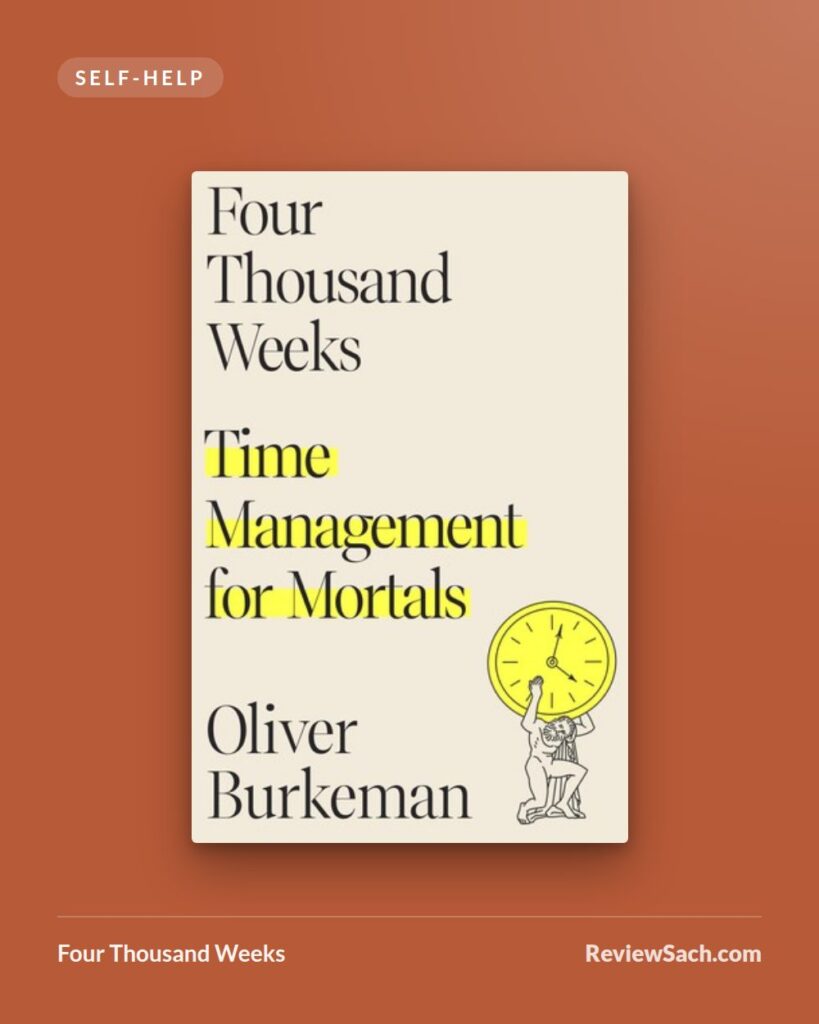
Author: Oliver Burkeman · Published: 2021 · Genre: Self-Help, Philosophy
Four Thousand Weeks argues that productivity culture rests on a false promise: that with enough efficiency, you’ll finally get on top of everything. You won’t, because an average life lasts only around four thousand weeks, and accepting that limit is the start of a better life. It’s the rare time-management book that leaves you calmer rather than more anxious. Read it if you’ve tried every system and still feel behind.
The big idea
Burkeman, who spent years writing a column about self-help for The Guardian, starts with simple arithmetic: live to 80 and you get roughly 4,000 weeks. From there he argues that most of our struggles with time come from refusing to accept that we are finite.
His central concept is the “efficiency trap.” The better you get at clearing tasks, the more tasks arrive. Answer email faster and you get more email. Become known as reliable and you get more requests. So the goal can’t be to do everything. It has to be choosing, deliberately, what to neglect.
He draws on philosophy, including Heidegger’s idea that we don’t just have time but are made of it, and on his own years chasing the perfect productivity system. He also offers what he calls “cosmic insignificance therapy.” Measured against the universe, your life barely registers. Rather than being depressing, he argues, that’s a relief: you can stop straining to do something monumental and focus on what matters to you and the people around you.
He also defends “atelic” activities, done for their own sake rather than to reach an outcome, like a walk with no destination. His warning is that treating rest and hobbies as tools for future productivity ruins them, and turns the whole of life into preparation for a future that never quite arrives.
What works
- It names the real problem. Instead of promising another system, Burkeman explains why systems keep failing. That diagnosis alone is a relief for anyone who blames themselves for never catching up.
- The tools follow from the argument. An appendix offers ten practical tools, such as keeping a strictly limited list of active tasks, deciding in advance which areas of life you’ll let slide, and working on one big project at a time. They’re few, but they’re well chosen.
- Sharp chapters on attention and patience. He argues that distraction and the urge to hurry are often ways of escaping the discomfort of our limits. Framed that way, the fix isn’t more willpower but tolerating that discomfort.
- The prose. Burkeman is funny, humane and unpreachy. He writes as a fellow sufferer, not a guru, and the book is a pleasure to read.
What doesn’t
- Light on how-to. Readers expecting a method will find the practical section short, and much of it restates the argument.
- Easier with some freedom. Advice to choose what to fail at works best when you control your schedule. Someone working two jobs and caring for a parent may find the philosophy consoling but hard to act on. The book’s natural audience is overloaded knowledge workers.
- Some repetition. The core insight is simple, and a few middle chapters circle it rather than advancing it.
- Not for optimizers. If you enjoy systems and simply want to get more done, the book’s gentle skepticism may frustrate you. It questions the goal rather than helping you reach it faster, and some readers will find that more annoying than liberating.
Who should read it
Read it if productivity advice has left you feeling worse, or if you want a thoughtful book about mortality that never turns morbid. If you need a concrete system, pair it with something more practical; this book explains why, not exactly how.
Rating: 4.5/5
Image credits — Cover image via Open Library. Cover design © the publisher, shown for review purposes.
