

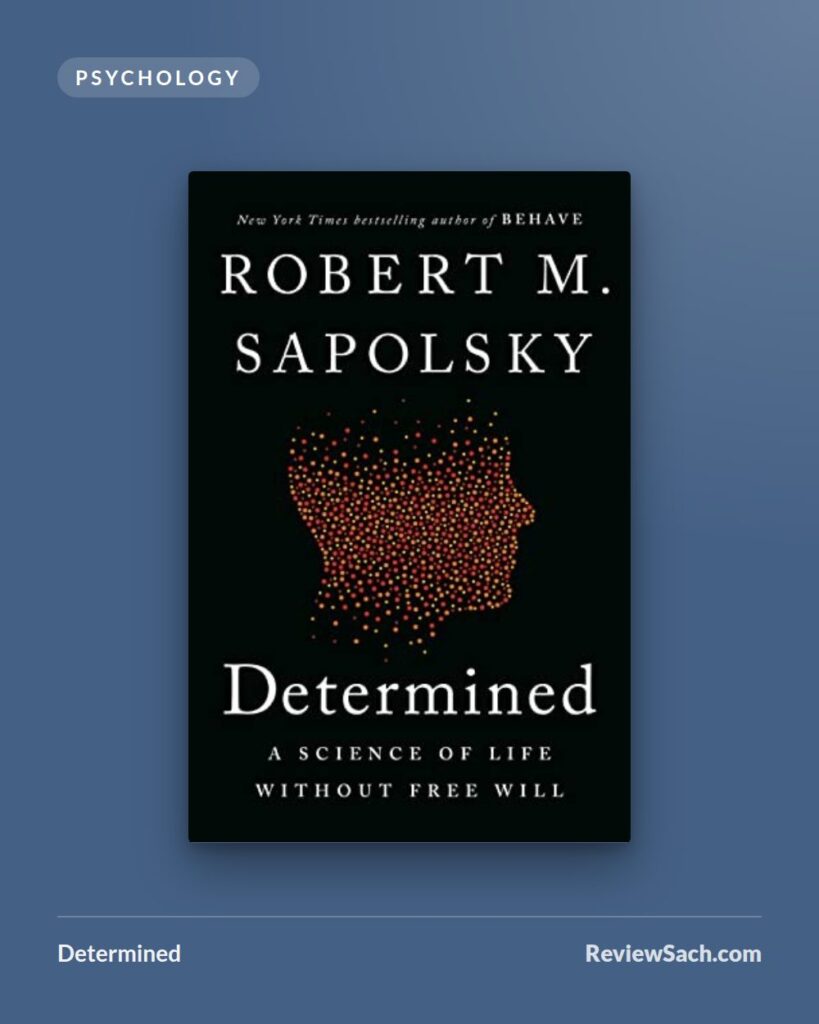
Author: Robert M. Sapolsky · Published: 2023 · Genre: Psychology, Neuroscience, Philosophy
Determined argues that there is no free will at all, not even a little, and that we should rebuild how we think about blame, punishment and praise accordingly. Sapolsky writes with the same wit and learning as in Behave, and the second half, on what a world without blame could look like, is humane and genuinely challenging. But his dismissal of the main philosophical alternative is too quick. Read it for the science and the moral vision, not as the last word on the debate.
The big idea
Sapolsky’s argument is simple to state. Every behavior is the product of what happened a second earlier in your brain, which was shaped by hormones, childhood, prenatal environment, genes, culture and evolution: the chain of causes he laid out in Behave. You chose none of those. So where, he asks, could free will slip in? He challenges believers to show him a neuron that acted independently of everything that caused it.
The first half works through the escape routes people propose. Sapolsky argues that the famous Libet experiments on the timing of conscious decisions are a sideshow, and that chaos theory, emergent complexity and quantum indeterminacy don’t help either. Unpredictable isn’t the same as free, and randomness at the quantum level wouldn’t give you control. He also targets the idea that effort and willpower are yours to take credit for, since the capacity for grit is itself shaped by biology and upbringing.
The second half asks what follows. His model is history. People once blamed epileptic seizures on witchcraft or sin, and now treat them as medical events. He argues we can do the same with behavior, restraining dangerous people to protect others, much like a quarantine, without believing they deserve to suffer.
What works
- The science is vast and well explained. Sapolsky moves from neurons to genetics to childhood adversity with clarity and humor, and the footnotes are as entertaining as ever.
- The case against retribution is strong. Whatever you think about free will, the chapters on how much harmful behavior traces to brain injury, poverty and early trauma are hard to shake.
- It takes the obvious worry seriously. Sapolsky asks whether abandoning belief in free will would make people behave worse, reviews research on that question, and admits that he himself can’t consistently live by his conclusions.
What doesn’t
The main criticism, made by philosophers in several prominent reviews, is that Sapolsky largely brushes aside compatibilism. That’s the view, held by most professional philosophers, that free will is compatible with determinism because it concerns whether you act from your own reasons and values, free of coercion, not whether your choices escape physical causation. Sapolsky defines free will in the strongest possible way, as something uncaused, and then shows it doesn’t exist. Critics argue that few serious thinkers defend that version, so much of the book knocks down a position hardly anyone holds.
Reviewers also noted that the book engages only lightly with the philosophical literature on moral responsibility. Several argued that it treats a philosophical question as though more neuroscience could settle it, when the dispute is mostly about what free will means.
The practical program is also thin. The quarantine model is appealing in outline, but Sapolsky says little about how it would handle deterrence, proportionality or who decides when someone is safe to release.
Finally, the book is long and repetitive in places. The central point is made early and restated many times.
Who should read it
Readers who loved Behave or care about criminal justice reform will get the most from it. Anyone persuaded by Sapolsky should also read a good defense of compatibilism, since the book doesn’t give that side a fair hearing.
Rating: 3.5/5
Image credits — Cover image via Open Library. Cover design © the publisher, shown for review purposes.
