

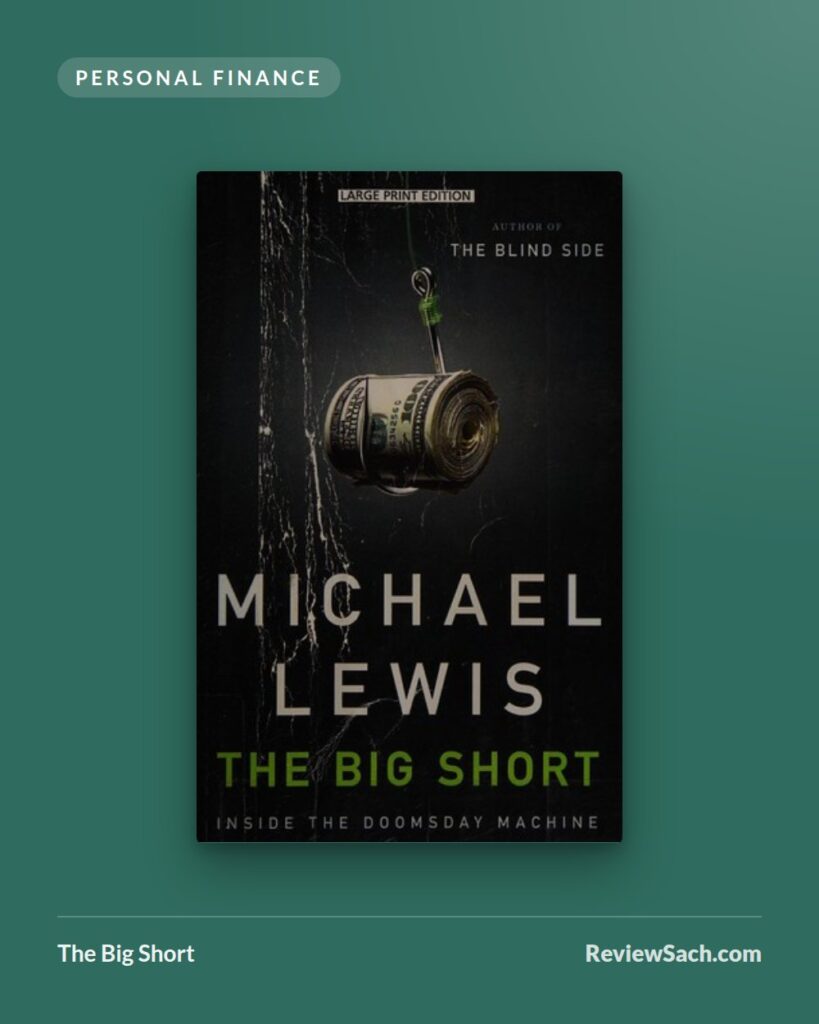
Author: Michael Lewis · Published: 2010 · Genre: Personal Finance, Business, History
The Big Short tells the story of the 2008 financial crisis through the handful of investors who saw it coming and bet against the subprime mortgage market. Its biggest strength is Lewis’s gift for character: he makes credit default swaps and CDOs understandable by attaching them to vivid, odd people. Its biggest limitation is that focus: by following the winners, the book leaves regulators, borrowers and policy mostly in the background. It is worth reading for anyone who wants to understand how the crisis happened, and it is more detailed and more cautious than the film.

What it’s about
In the mid-2000s, lenders made home loans to borrowers who could not repay them, and Wall Street bundled those loans into bonds and then into more complex products called collateralized debt obligations. Ratings agencies gave many of them top grades. A few outsiders looked at the underlying loans, concluded the system would break, and bought credit default swaps, a kind of insurance that pays off if bonds fail.
Lewis follows Michael Burry, a former medical resident running Scion Capital in California, who read mortgage prospectuses obsessively; Steve Eisman, a combative money manager at FrontPoint Partners; Greg Lippmann, a Deutsche Bank trader who promoted the bet to clients; and Cornwall Capital, a tiny fund started by Charlie Ledley and Jamie Mai and later joined by the veteran trader Ben Hockett. Their certainty is tested as the market refuses to move for months, and their investors grow impatient.
What’s great
- Clarity. Lewis explains tranches, synthetic CDOs and swaps in plain English and in the moment they matter to his characters, which is how most readers will finally understand them.
- Characters. Burry’s isolation, Eisman’s anger and Cornwall’s amateur luck give the book the pace of a novel. Eisman’s grief over the death of his young son is handled with restraint.
- The insiders. Some of the strongest chapters follow the other side: AIG’s financial products unit, where Gene Park raised alarms about the company’s exposure, and Morgan Stanley’s Howie Hubler, whose subprime bet produced one of the largest trading losses in Wall Street history.
- Moral seriousness. Lewis ends with lunch with his old Salomon Brothers boss John Gutfreund, linking the crisis to changes he first described in Liar’s Poker.
How it differs from the film
Adam McKay’s 2015 film, which won the Oscar for best adapted screenplay, keeps the core story but changes a lot. Only Burry keeps his real name: Eisman becomes Mark Baum, Lippmann becomes Jared Vennett, Ledley and Mai become Charlie Geller and Jamie Shipley, and Hockett becomes Ben Rickert. Eisman’s real loss of a child is replaced by a fictional brother’s suicide. The film adds fourth-wall narration and celebrity cameos to explain jargon. The book has far more on the mechanics, the ratings agencies and AIG.
What’s weak
The outsider framing simplifies blame. Lewis concentrates on Wall Street’s greed and incompetence, and says much less about regulators, government housing policy or the borrowers themselves, so readers get a vivid but partial picture. John Paulson, who made the most famous fortune from the crash, appears only in passing.
The heroes are also flattered by hindsight. Their insight was real, but the book spends less time on the many people who made similar bets too early and lost. And since the protagonists profited from a disaster that cost millions of people their homes and jobs, some readers find the celebratory tone uncomfortable, although Lewis does show their unease.
Who should read it
Read it if you want a readable account of how the 2008 crisis was built, or if you saw the film and want the fuller story. It explains how markets failed, but it is not a guide to investing.
Rating: 4.5/5
Image credits — Featured image: cover image via Open Library; cover design © the publisher, shown for review purposes. In-article images: Photo by Supradoc on Unsplash.
