

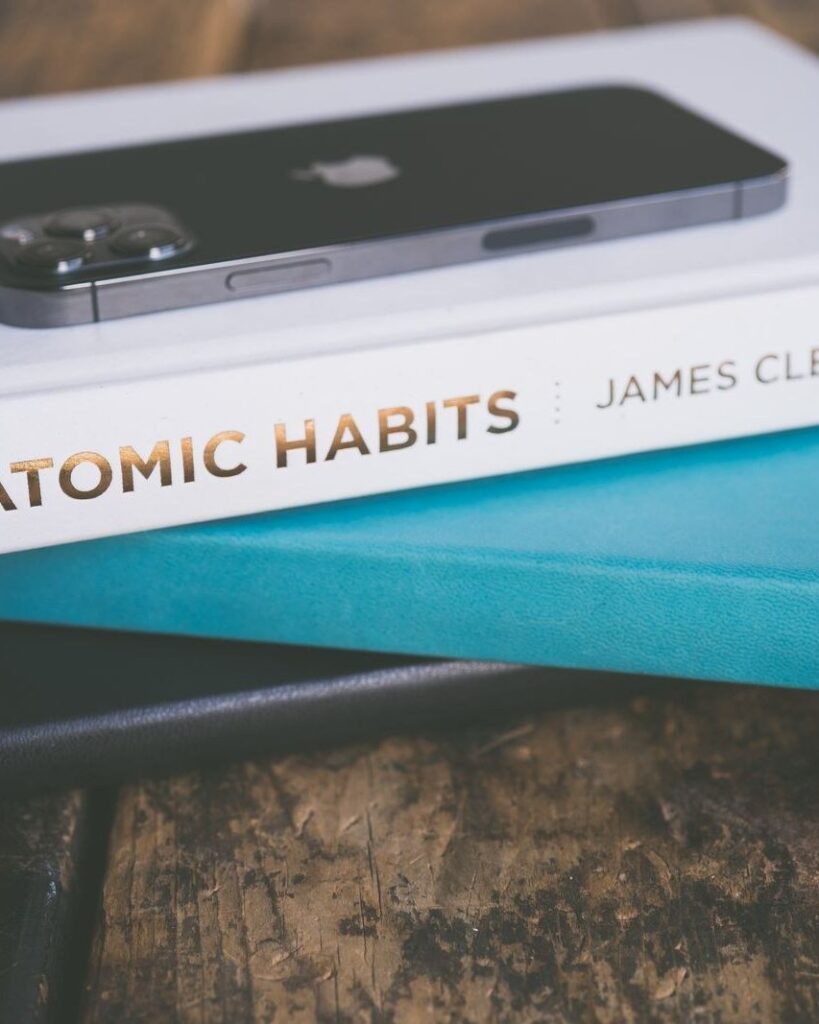
Author: James Clear · Published: 2018 · Genre: Self-Help, Habits
Atomic Habits argues that lasting change comes from tiny, repeatable improvements built into your environment, not from motivation or big goals. It’s the most usable habit book I know: short chapters, a simple framework and a tactic on almost every page. Read it if you want to start exercising, stop scrolling or finish projects. Skip it if you want new science, because most of the research here is borrowed.
The big idea
Clear writes from experience. In the introduction he describes being hit in the face by a baseball bat in high school and rebuilding his life, and later his athletic career, through small, consistent habits rather than dramatic turnarounds.
His starting point is compounding. Getting one percent better each day adds up to a large difference over a year, while one percent worse quietly drags you down. The catch is that results lag behind effort, so people quit during what he calls the plateau of latent potential, before the gains show up.
His answer is to focus on systems instead of goals, and on identity instead of outcomes. Rather than aiming to run a marathon, you aim to become the kind of person who runs. Every workout is a vote for that identity.
The practical core is the Four Laws of Behavior Change, built on a loop of cue, craving, response and reward. To build a habit, make it obvious, attractive, easy and satisfying. To break one, flip each law: make it invisible, unattractive, difficult and unsatisfying.
What works
- It’s concrete. Habit stacking, where you attach a new habit to an existing one (after I pour my coffee, I meditate for a minute), and the two-minute rule, which shrinks any new habit to a version you can finish in two minutes, are tools you can use the same day.
- Environment beats willpower. Clear’s best chapters argue that disciplined people aren’t stronger; they just arrange their surroundings so temptation rarely shows up. He cites a hospital cafeteria that sold more water and less soda simply by putting bottled water in more visible places.
- The structure is excellent. Each law gets a few short chapters and a summary at the end. The book works as a reference you return to, not just a one-time read.
- It plans for failure. His rule to never miss twice accepts that you’ll slip, and focuses on getting back on track quickly instead of chasing a perfect streak.
- The identity angle sticks. Linking habits to who you want to be gives small actions a reason beyond discipline, and it’s the idea readers most often say stayed with them.
What doesn’t
Little here is original. The habit loop extends Charles Duhigg’s cue, routine and reward from The Power of Habit, adding craving as a separate step. Habit stacking builds on BJ Fogg’s work and on research into implementation intentions. Clear credits his sources, but readers who know the genre will find it familiar.
The anecdotes are also very neat. The first chapter’s showcase, British Cycling’s rise under Dave Brailsford through “marginal gains”, reads less cleanly now, given later controversies over medical practices in British cycling and Team Sky. More broadly, the book treats most failure as a design problem. That can underplay poverty, depression, addiction or chaotic work schedules that no habit tracker will fix.
The one-percent math is more metaphor than measurement, since real life doesn’t compound that smoothly. And the back half gets repetitive, restating points the early chapters already made well.
Who should read it
Anyone who keeps restarting the same resolution, and anyone new to self-help who wants one book with a clear, practical method. If you’ve already read Duhigg and Fogg, the chapter summaries will give you most of what’s new.
Rating: 4.5/5
Photo credits — Featured image: Photo by Jessica Lewis (thepaintedsquare) on Pexels. In-article photo: Photo by Nubelson Fernandes on Unsplash.
