

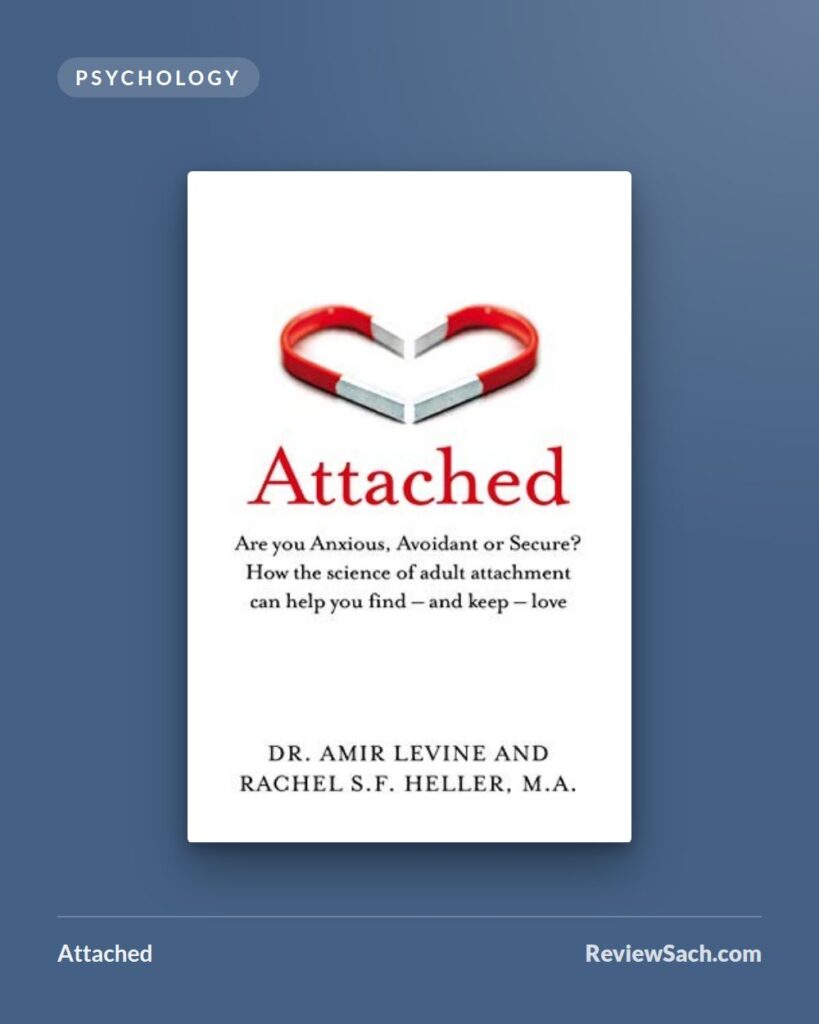
Author: Amir Levine and Rachel Heller · Published: 2010 · Genre: Psychology, Relationships, Self-Help
Attached applies adult attachment theory to dating and relationships, arguing that knowing whether you and your partner are secure, anxious or avoidant explains many of your recurring conflicts. It’s clear, practical and often eye-opening, especially for anxious readers who’ve been told they’re too needy. But it turns a complex research field into tidy boxes and sometimes reads like a dating rulebook. A good starting point, not the final word.
The big idea
Attachment theory began with John Bowlby and Mary Ainsworth’s work on how infants bond with caregivers. In the 1980s, researchers including Cindy Hazan and Phillip Shaver extended it to adult romantic relationships. Levine, a psychiatrist and neuroscientist at Columbia University, and Heller, who has a background in psychology, translate that research for a general audience.
They describe three main styles. Secure people are comfortable with intimacy and don’t worry much about rejection. Anxious people crave closeness and are highly sensitive to signs of distance. Avoidant people prize independence and feel uneasy when partners get too close. A small group combines anxiety and avoidance. Underneath all three is what the authors call the attachment system, an inborn mechanism that monitors a partner’s availability and sounds the alarm when closeness seems threatened.
The book’s key claim is the dependency paradox: the more securely people can depend on a partner, the more independent and confident they become. Needing your partner isn’t a weakness; it’s how humans are built.
What works
- It validates anxious readers. Many dating guides tell people to play it cool. Attached argues that wanting closeness is normal, and that the real problem is pairing with someone who keeps withdrawing it.
- The concepts are memorable. Protest behavior, such as calling repeatedly or threatening to leave when an anxious person feels ignored, and deactivating strategies, such as fixating on a partner’s flaws or idealizing an ex, give readers language for patterns they recognize.
- The anxious-avoidant trap is well explained. The book shows how an anxious partner’s pursuit and an avoidant partner’s withdrawal feed each other, and why the resulting rollercoaster can be mistaken for passion. It also argues that secure partners are often overlooked because, next to that drama, they can seem boring.
- It gives practical tools. Questionnaires help readers assess themselves and their partners, and the advice on effective communication, stating your needs directly and early, is sound.
What doesn’t
The biggest problem is oversimplification. Researchers today mostly treat adult attachment as two continuous dimensions, anxiety and avoidance, rather than fixed types. People can shift over time and behave differently with different partners. The book acknowledges that styles can change but leans heavily on labels, which can encourage readers to diagnose partners rather than understand them.
Avoidant readers get a rough deal. The book is written mainly for anxious and secure readers, and avoidants often come across as the problem to be screened out, with less help on how they might change.
The advice can also be blunt. Telling anxious readers to rule out avoidant dates early may be sensible, but it can make relationships sound like a sorting exercise rather than something two people build together.
Finally, the examples are mostly heterosexual couples, and the case stories wrap up a little too neatly, which narrows the book’s range and makes change look easier than it usually is.
Who should read it
Anyone stuck in a repeating relationship pattern, especially readers who worry they’re too needy, will find it clarifying. Therapists and psychology readers should treat it as a friendly introduction and follow up with research that treats attachment as a spectrum.
Rating: 3.5/5
Image credits — Cover image via Open Library. Cover design © the publisher, shown for review purposes.
