

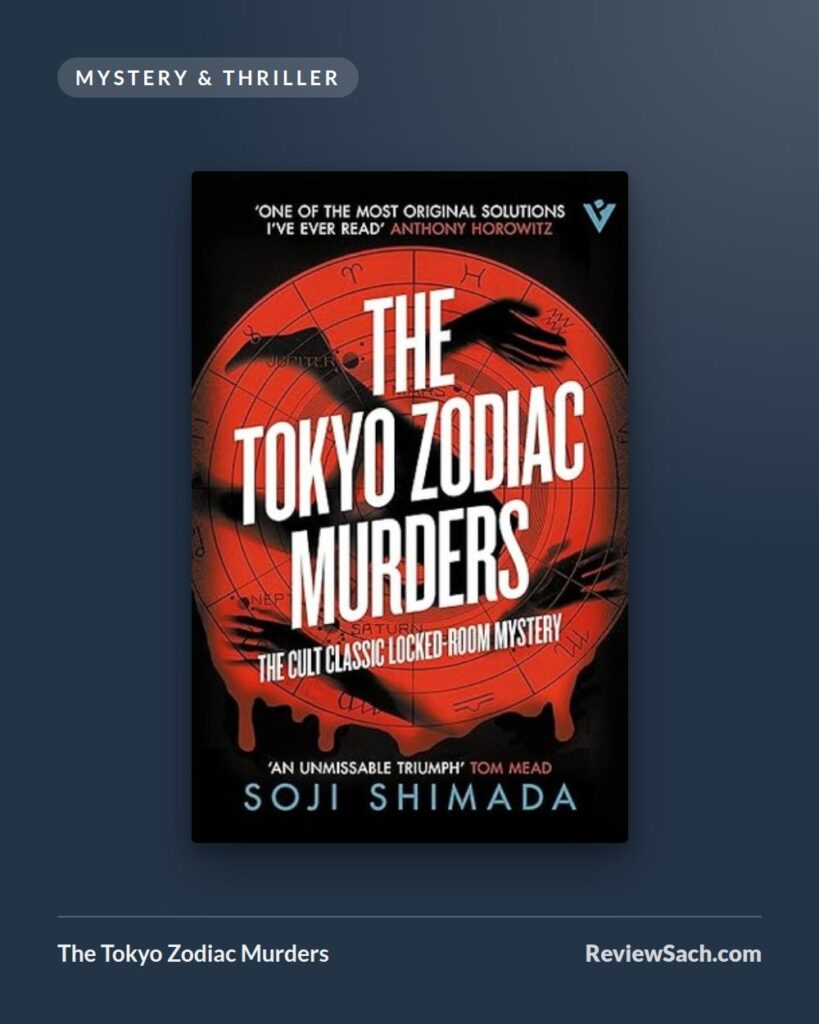
Author: Soji Shimada · Published: 1981 · Genre: Honkaku Mystery, Locked Room · Original title: Senseijutsu Satsujin Jiken
The Tokyo Zodiac Murders is a pure puzzle mystery whose solution is so clever it has become famous in its own right. The prose is flat and the first half is heavy with exposition, but the payoff is worth the effort. If you enjoy fair-play detective stories that challenge you to beat the detective, it’s essential. If you read mysteries mainly for character, it may frustrate you.
What it’s about
In 1936, an eccentric Tokyo painter, Heikichi Umezawa, is found dead in his studio, which is locked from the inside. He leaves behind a strange manuscript describing a plan to kill young women of his household, each born under a different star sign, and assemble a perfect woman, Azoth, from their bodies. Soon afterwards, six young women connected to him, his daughters, stepdaughters and nieces, are found murdered and mutilated, their bodies buried at sites across Japan in a way that seems to follow his plan. But Umezawa was already dead.
The case becomes a national obsession and stays unsolved for some forty years. In 1979, Kiyoshi Mitarai, an astrologer and fortune-teller with a brilliant mind and a moody temperament, takes it on with his friend Kazumi Ishioka, an illustrator and mystery fan who narrates. Working mostly from old documents, they set out to crack what the police and a whole country of amateur sleuths could not.
What works
- The solution. It’s elegant, simple and completely fair. Once revealed, it makes you wonder how you missed it, which is the best thing a puzzle mystery can do. I won’t hint at it.
- Challenges to the reader. In the tradition of Ellery Queen, Shimada steps in to tell you that you now have every clue you need. It turns the book into a game between writer and reader, and it’s a real thrill to pause and test your own theory.
- The Holmes-and-Watson pair. Mitarai is abrasive, mercurial and brilliant. Ishioka is loyal and a step behind. Their bickering adds life to otherwise dry pages, and Mitarai’s grumpy dismissal of Sherlock Holmes is a highlight.
- Its influence. This debut made Shimada the godfather of Japan’s “shin honkaku” movement, a revival of the classic fair-play puzzle. Writers such as Yukito Ayatsuji, author of The Decagon House Murders, followed in its wake.
What doesn’t
The first half is a slog. Long passages of astrology, alchemy and case summary arrive through documents and lectures, and the two detectives spend a lot of time recapping the same facts. Apart from the detectives, the characters barely exist, and the women at the centre of the crime are little more than names on a family tree. The dialogue can be stiff in English.
Some details of the crime also strain plausibility if you think about them too hard. The maps and diagrams are useful, but they don’t make the middle chapters any livelier.
One warning: the central trick was later borrowed by an episode of the popular manga The Kindaichi Case Files, so spoilers are out there. Avoid online discussion of either work before you read this one. Reprints of the manga story reportedly now advise readers to finish Shimada’s novel first.
The English translation by Ross and Shika Mackenzie, published by Pushkin Vertigo in 2015, is plain and serviceable rather than elegant.
Who should read it
Fans of John Dickson Carr, Ellery Queen and locked-room puzzles, and anyone curious about classic Japanese crime fiction. Go in expecting a game, not a novel of character. If you enjoy it, try The Decagon House Murders next. Both show a love of the pure puzzle that English-language crime fiction largely abandoned decades ago.
Rating: 4/5
Image credits — Cover image via Open Library. Cover design © the publisher, shown for review purposes.
