

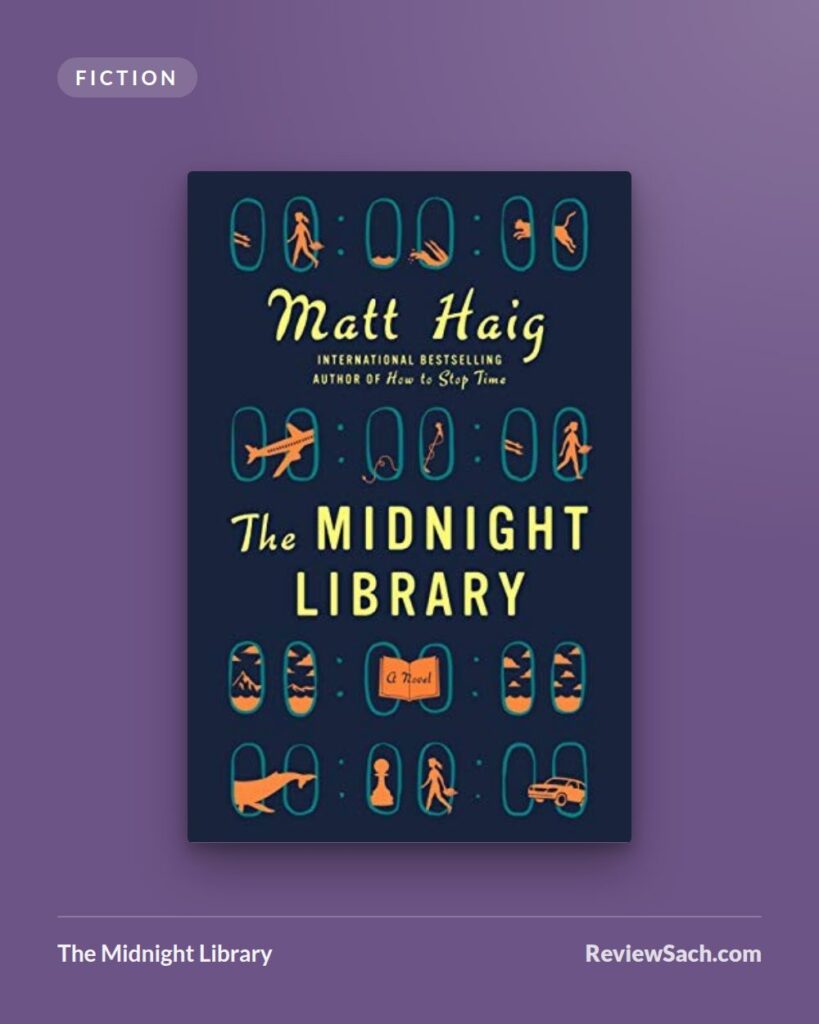
Author: Matt Haig · Published: 2020 · Genre: Speculative Fiction, Contemporary Fiction
The Midnight Library is a short, gentle fable about regret, built around one question: what if you could try the lives you didn’t choose? It’s warm, quick and sincere, and it has clearly comforted a lot of readers. But its ideas are simple, its characters are thin, and you’ll see where it’s heading long before you get there. Good for a lift, not for depth.
What it’s about
Nora Seed is 35 and living in Bedford, England. Within a single day she loses her job at a music shop and her cat, Voltaire, is found dead, and whatever hope she had left goes with them. She tries to end her life. Instead of dying, she finds herself in a library that exists between life and death, run by a version of Mrs. Elm, the school librarian who was kind to her as a girl.
Every book on the shelves is a different version of Nora’s life, the one she would have lived if she had made a single choice differently. There’s also a heavy Book of Regrets, listing everything she wishes she had done. By opening a book, Nora can step into that life and stay if it feels right. She tries many: Olympic swimmer, rock star, glaciologist in the Arctic, philosophy lecturer, wife, mother and more. Each one tests a specific regret: the swimming career she abandoned, the band she quit with her brother, the fiancé she left just before their wedding. Whenever a life disappoints her, she’s pulled back to the library to choose again.
What works
- The premise. It’s a great hook, and Haig uses it well. Each life is a quick, vivid sketch, and the variety keeps the pages turning.
- Honesty about depression. Haig has written openly about his own depression in Reasons to Stay Alive, and Nora’s state of mind at the start is described with recognizable accuracy. The book treats despair as something that lies to you about the future, a message that lands.
- The central lesson. Every dream life has disappointments of its own. The idea that no life is free of regret, and that small daily things can matter more than grand achievements, is simple but useful.
- Mrs. Elm. The kind librarian gives the book its best scenes, part guide and part memory of being cared for. In Nora’s real past, she was the adult who played chess with her at school and stayed with her on a very bad day.
What doesn’t
The philosophy is shallow. Nora studied philosophy, and the book leans on Thoreau and on popular ideas about quantum physics and parallel worlds, but the thinking stays at the level of inspirational quotes. Many critics called it simplistic, and the multiverse logic doesn’t survive much scrutiny.
The characters, apart from Nora, barely exist. Her brother Joe, her ex-fiancé Dan and her friend Izzy are defined mostly by how Nora let them down. And because the book is so clearly building toward one message, the ending holds few surprises. The writing is plain and aphoristic, with short chapters that sometimes hold a single thought, which some readers find refreshing and others find closer to a self-help book than a novel.
Some readers also feel uneasy about a feel-good fable framed by a suicide attempt. Haig handles it carefully and without graphic detail, but readers in a raw place should know it is there from the opening chapters.
Who should read it
Readers who want a hopeful, easy book, particularly anyone stuck on regret about paths not taken. It also suits people who don’t usually read fiction; its simplicity is a big part of its reach. It won the 2020 Goodreads Choice Award for Fiction. If you want a novel that explores the same ideas with more rigor and ambition, try Kate Atkinson’s Life After Life instead.
Rating: 3.5/5
Image credits — Cover image via Open Library. Cover design © the publisher, shown for review purposes.
