

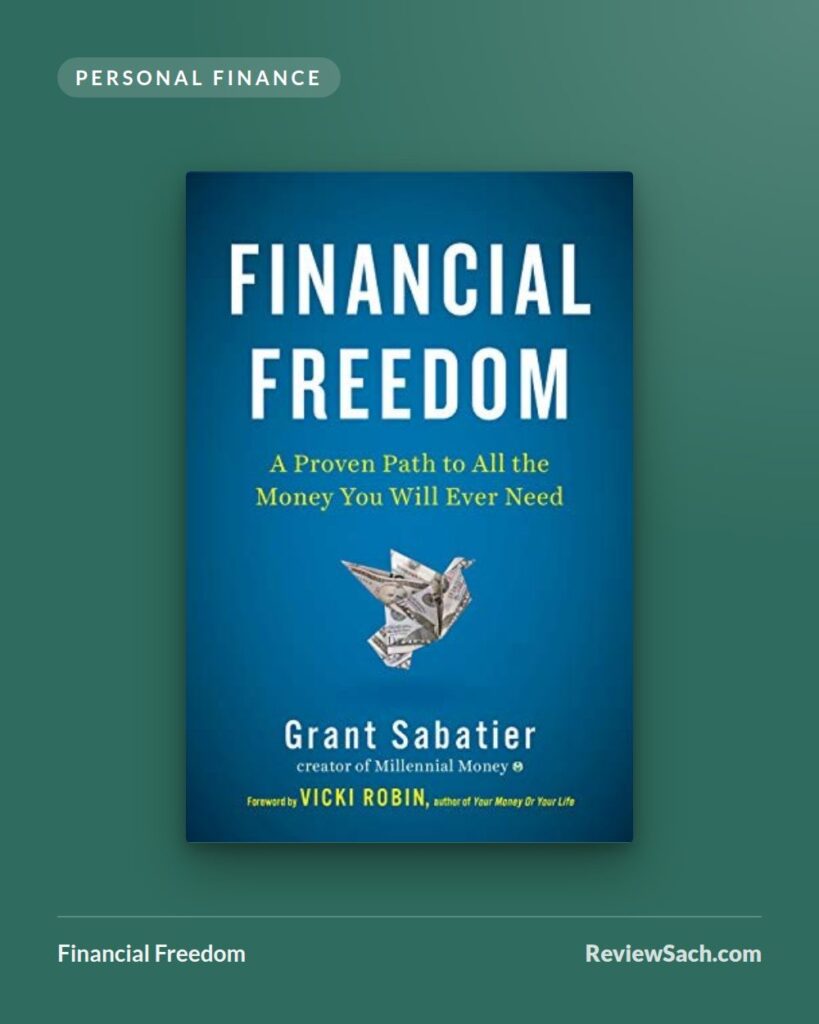
Author: Grant Sabatier · Published: 2019 · Genre: Personal Finance, Early Retirement
Financial Freedom is the most earning-focused of the major early-retirement books. Grant Sabatier argues that time, not money, is your scarcest resource, and that the fastest path to independence is to earn much more, save a large share and invest it. It is energetic and packed with tactics, but its best results depend on skills, health and hustle not everyone has.
The big idea
Sabatier’s own story frames the book. In 2010, at 24, he had $2.26 in his bank account. About five years later his net worth had passed $1.25 million, and CNBC dubbed him the “Millennial Millionaire”. He got there by teaching himself digital marketing, landing an agency job, building a consulting business on the side, saving most of his income and investing the difference.
His core claim is that money is unlimited but time is not. Rather than asking whether you can afford something, he suggests asking how many hours of work it costs and what that money would grow into if invested instead. From there he helps readers calculate a personal “freedom number”, roughly 25 times annual spending under the 4% rule. He also lays out seven levels of financial freedom: clarity, self-sufficiency, breathing room, stability, flexibility, financial independence and abundant wealth.
A counterintuitive point runs through the book: you may need less money to stop working at 30 than at 65, because a younger person can keep earning a little and has decades for investments to compound.
What works
- Income first. Unlike books that obsess over coffee, Sabatier argues that there is a floor to how much you can cut but no ceiling on how much you can earn. His chapters on negotiating salary and building side income are detailed and practical.
- Big expenses over small ones. He focuses on housing, transport and food, where the real savings sit, instead of guilt over small treats.
- Clear investing basics. Maximise tax-advantaged accounts, buy low-cost index funds and keep fees down. Nothing fancy, which is the point.
- Spending as a time trade. His habit of asking, before a purchase, how many hours of work it costs and what the money could grow into is simple and sticks. It reframes frugality as protecting your time rather than denying yourself.
- Useful milestones. The seven levels give readers a sense of progress long before full independence, which helps motivation over a long haul.
What doesn’t
Survivorship bias hangs over the book. Sabatier’s route combined digital skills in a booming field, long hours and a strong stock market in the early 2010s. Readers who try to copy it may find side hustles far less lucrative, and the pace he describes would burn many people out, with costs to health and relationships that the book underplays.
It also shares the wider debate around early retirement. A 4% withdrawal rate was designed around roughly 30-year retirements, and critics argue that some FIRE writers downplay the extra risk of stretching a portfolio across 50 years or more. In practice, many early retirees, Sabatier included, keep earning from projects, so “retirement” often means flexible work rather than none at all.
The tone is relentlessly upbeat. That energises some readers, but it can make an unusually successful outcome sound more typical than it is.
Who should read it
Young professionals with marketable skills and energy to spare who want a fast, aggressive plan. If your income is fixed or your time is already stretched by caring or health, take the mindset and the investing basics and leave the hustle. Even a slower version of his plan, with a higher savings rate and steady index investing, can shave years off a working life.
Rating: 3.5/5
Image credits — Cover image via Open Library. Cover design © the publisher, shown for review purposes.
