

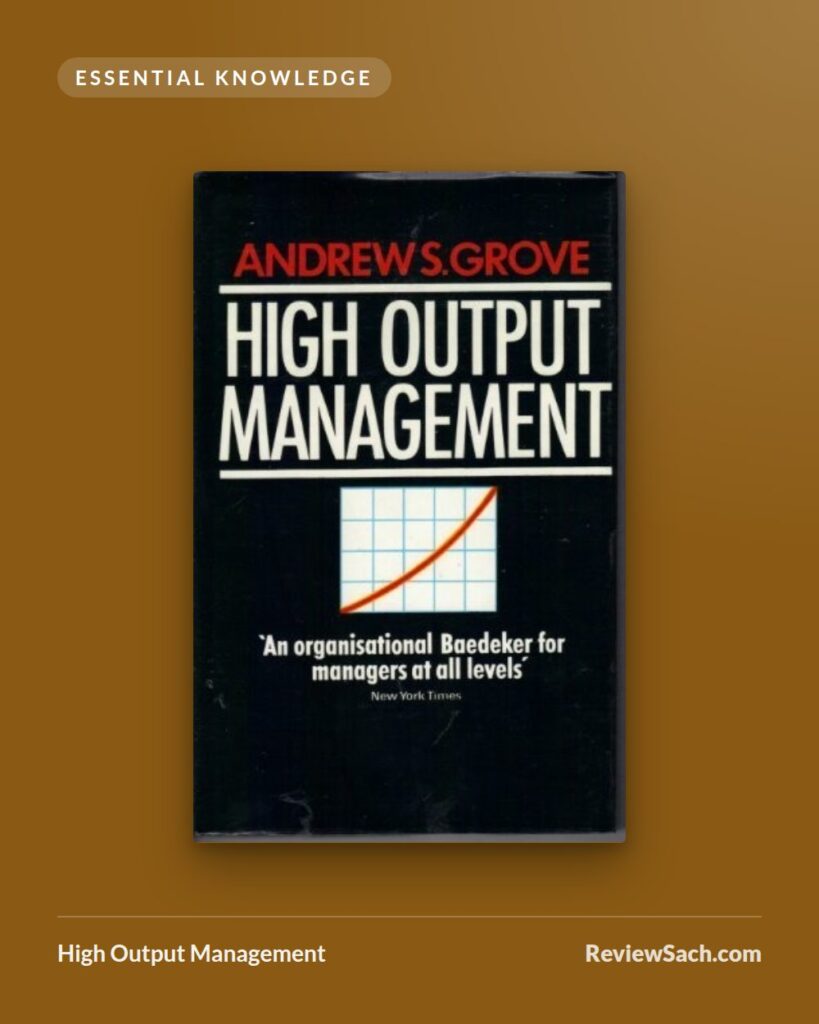
Author: Andrew S. Grove · Published: 1983 · Genre: Management, Business
High Output Management‘s biggest strength is that it treats management as a craft with measurable output and gives you concrete tools to improve it. Its biggest weakness is age: the examples come from 1980s semiconductor factories and a large, hierarchical company, and some chapters feel stiff today. It’s worth reading for any new manager, and it remains a favorite in the tech industry for good reason.

The core ideas
Grove wrote the book while he was president of Intel. His central ideas:
- Management is production. He explains production principles with a diner serving a breakfast of a boiled egg, buttered toast and coffee. The slowest step, the egg, sets the schedule for everything else, and problems are cheapest to catch at the lowest-value stage.
- A manager’s output. A manager’s output is the output of their organization plus the output of the neighboring organizations they influence. The job is to pick high-leverage activities, such as training or decisions that affect many people.
- Indicators. Measure output, not activity, and use paired indicators so that pushing one number doesn’t quietly damage another. His example is tracking inventory levels alongside shortages.
- Task-relevant maturity. The right management style depends on how experienced someone is with a specific task. Give close structure to people new to a task and more freedom to those who have mastered it.
- Objectives and key results. Grove’s version of management by objectives asks where you want to go and how you will know you are getting there. It is the ancestor of the OKR system that John Doerr later took from Intel to Google.
What’s great
It’s relentlessly practical. The chapter on one-on-ones is still the best short guide to the practice: the meeting belongs to the subordinate, who sets the agenda, and the manager’s job is to listen, ask questions and teach. His advice on meetings splits them into process meetings, such as one-on-ones and staff meetings, and mission meetings called for a specific purpose, which usually end in a decision.
His model for decisions is also excellent. Start with free discussion where everyone speaks openly, reach a clear decision, then expect full support, even from people who argued against it. Few management books explain this so plainly.
Grove also insists that training is one of a manager’s highest-leverage activities, and that managers themselves should do it. That point alone justifies the read for anyone running a growing team.
What’s weak
The examples are dated. Much of the book is set on Intel production lines and in paper-memo offices, with nothing on remote work, modern software teams or startups. Readers must translate the breakfast factory into their own world, and some will find the manufacturing detail tedious.
Several chapters assume a large, stable hierarchy. The long discussion of dual reporting and hybrid organizations, and the fairly rigid approach to performance reviews and compensation, suit a big corporation more than a small team. The motivation chapter leans on Maslow’s hierarchy of needs, a framework that psychologists now regard as lacking strong empirical support.
The tone can also be dry. Grove writes like an engineer: clear and precise, but with little storytelling.
Who should read it
Every new manager should read it, starting with the chapters on one-on-ones, meetings and task-relevant maturity. The 2015 reissue is the easiest edition to find. Follow it with Ben Horowitz’s The Hard Thing About Hard Things for the startup perspective.
Rating: 4.5/5
Image credits — Featured image: cover image via Open Library; cover design © the publisher, shown for review purposes. In-article images: Photo by Benjamin Child on Unsplash.
