

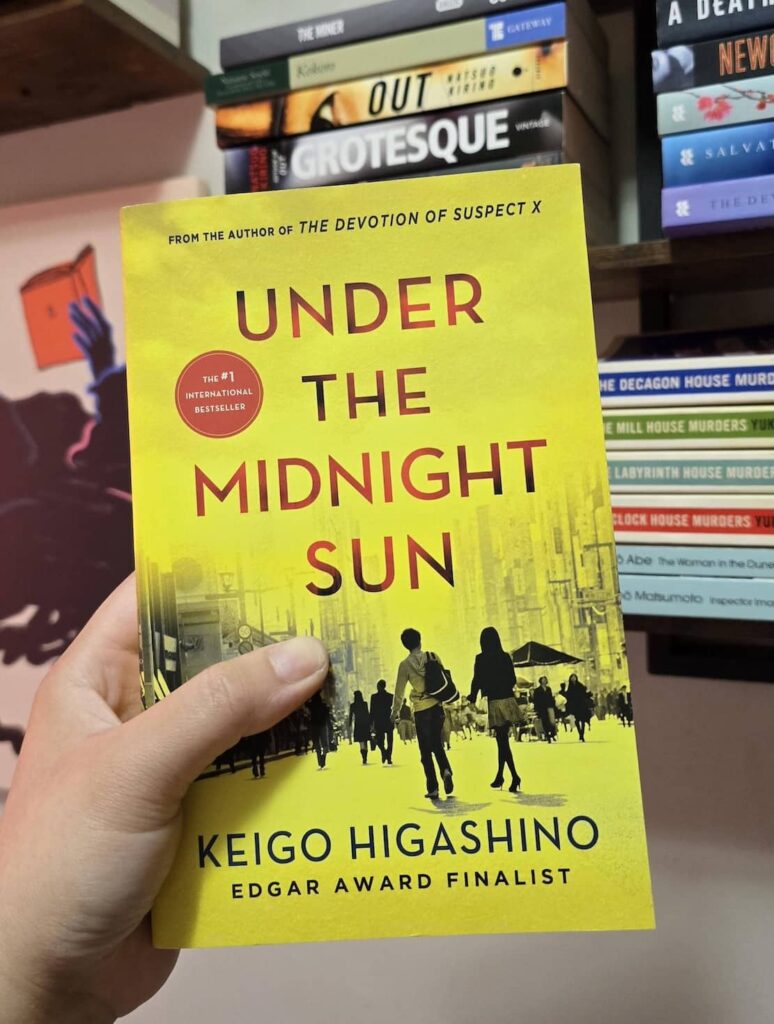
Author: Keigo Higashino · Published: 1999 (English translation by Alexander O. Smith, 2015) · Original title: Byakuyakō · Genre: Mystery, Crime
Keigo Higashino is best known in English for The Devotion of Suspect X. Journey Under the Midnight Sun is bigger, darker and, in my opinion, more devastating. It’s a slow-burning crime saga that covers about twenty years of Japanese history, and it ends in a way that will stay with you long after the last page.
The setup (no spoilers)
In 1973, a pawnbroker named Yosuke Kirihara is found stabbed to death in an abandoned building in Osaka. Detective Junzo Sasagaki takes the case. Suspicion falls on Fumiyo Nishimoto, a woman the pawnbroker had been visiting, and her lover. But there’s no hard proof, both suspects soon die, and the case goes cold.
Two children stay in the background: the pawnbroker’s quiet son, Ryoji Kirihara, and Fumiyo’s daughter, Yukiho Nishimoto, a clever and unusually composed girl.
The novel then follows them as they grow up, over nearly two decades. Yukiho is adopted by a relative, becomes a stunningly beautiful and elegant woman, and climbs steadily up the social ladder. Ryoji drifts into the shadows and a string of shady schemes. Around both of them, people keep getting hurt: rivals are humiliated, secrets leak, and obstacles quietly disappear. Only Sasagaki, getting older and more obsessed, senses the pattern.
A brilliant structure
The most unusual thing about the book is that we almost never see inside Yukiho’s or Ryoji’s heads. Each chapter is told from the point of view of someone around them: a classmate, a colleague, a husband, a private investigator. The two main characters are rarely seen together, yet you slowly realize they’re connected. It feels like assembling a puzzle whose picture you don’t want to see.
Spoiler warning: the ending
Stop here if you haven’t read the book.
Sasagaki finally uncovers the truth. As a child, Yukiho was being sold by her own mother to the pawnbroker, a predator. Ryoji discovered it and killed his father. Yukiho later made sure her mother could never tell anyone. From that day on, the two children were bound by the crime. Yukiho would walk in the light and build the life she wanted, and Ryoji would stay in the dark, doing whatever was needed to protect her. The title points to this. Their lives were never lived under a real sun, only a pale, false daylight.
The ending comes on Christmas Day, at the opening of Yukiho’s new boutique in Osaka. Ryoji is there, dressed as Santa Claus. When the police close in, he flees to the top of the building and jumps to his death. When Yukiho is asked whether she knows the man, she says she doesn’t, and she walks away without looking back.
That’s what makes the ending so painful. Ryoji gave his whole life, and finally his death, to protect Yukiho, and in the end she won’t even acknowledge that he existed. Readers still argue about whether her coldness is ruthless survival or one last act of protecting their secret. Either way, it’s heartbreaking.
Weaknesses
The book is long, and the middle section can feel slow, with many characters and business subplots. Because we never hear the leads’ inner voices, some readers find it hard to connect. The themes are very dark, including child abuse, so it isn’t a light read.
Verdict
Journey Under the Midnight Sun is less a whodunit than a tragedy told as a crime novel. If you like patient, atmospheric mysteries with a sting in the tail, it’s one of Higashino’s finest, and one of his saddest.
Rating: 4.5/5
