

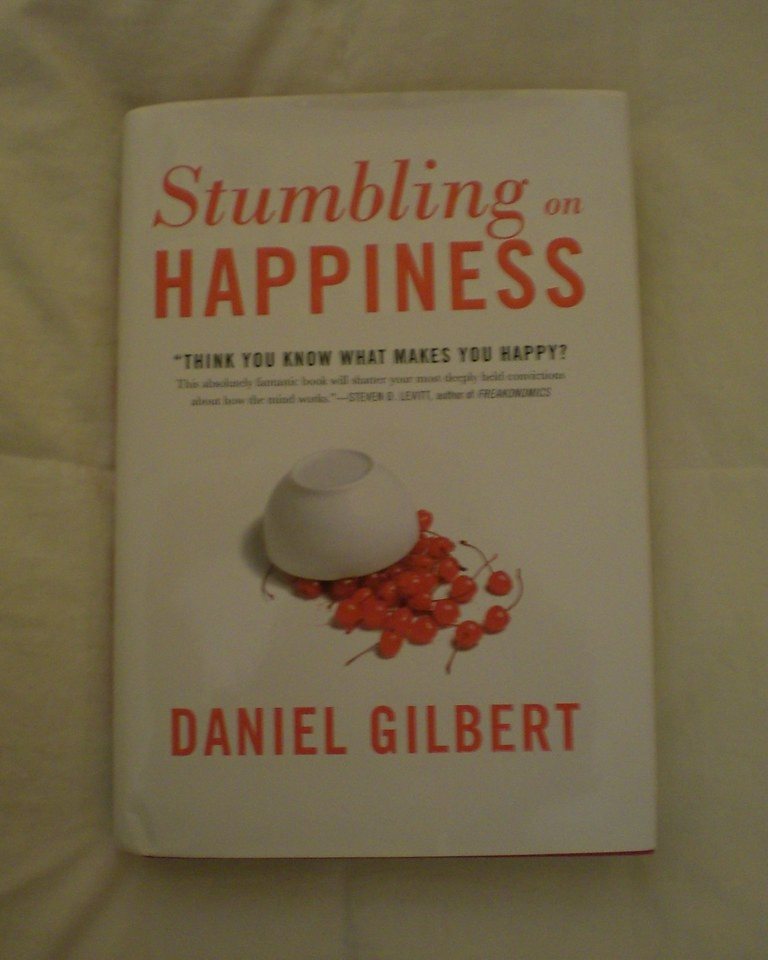
Author: Daniel Gilbert · Published: 2006 · Genre: Psychology, Happiness
Stumbling on Happiness argues that humans are bad at predicting what will make them happy, not because they lack willpower or information but because imagination has built-in flaws. It’s one of the funniest popular science books around, and its central insight is genuinely useful for big life decisions. It’s not a self-help book, though, so don’t expect a plan. Read it if you enjoy smart, playful explanations of how the mind works.

The big idea
Gilbert, a Harvard psychologist, studies what researchers call affective forecasting: our predictions about how future events will make us feel. He starts from the observation that humans spend an unusual amount of time thinking about the future, and then shows how often we get it wrong.
He groups the errors into a few families. Imagination fills in details that aren’t there and leaves out ones that matter, so the future we picture is thinner and simpler than the real one will be. It is also stuck in the present: we assume tomorrow’s self will feel the way we feel now, which is why people who shop for groceries while hungry buy more than they need. Finally, we underestimate our ability to cope. A psychological immune system reframes and rationalizes bad events, so setbacks hurt less, and for less time, than we expect.
His conclusion is counterintuitive. The best way to predict how you will feel about something is not to imagine it but to ask people who are experiencing it right now. Most of us reject this advice because we believe we are more unusual than we are.
What works
- The writing. Gilbert is a genuinely funny writer, and the jokes serve the argument. Dense research on memory, perception and judgment goes down easily, and the footnotes are often as entertaining as the main text.
- Great experiments. In one study he describes, a stranger asking for directions is swapped for a different person mid-conversation, and many people don’t notice. It’s a vivid demonstration of how little of the world we actually store, and how much our minds fill in.
- Challenging assumptions. He describes conjoined twins who say they are happy and don’t want to be separated, and research suggesting that marital satisfaction tends to fall after children arrive and recover once they leave home. These findings push hard against our confident intuitions about what makes a good life.
- A useful habit. Once you understand how imagination misleads you, you start doubting your own vivid predictions about a new job, city or purchase, which is healthy.
What doesn’t
The book is much stronger on diagnosis than prescription. After more than 200 pages on our forecasting errors, the solution fits in a few paragraphs, and Gilbert admits most people won’t follow it. Readers who want practical guidance may feel short-changed.
The humor can also wear thin. The running jokes and asides are charming at first, but some readers find them distracting in the denser middle chapters, where the argument needs more focus.
Some of the research comes from small lab studies of the kind the replication crisis has taught us to treat with caution, and the book presents them confidently. The broad pattern, that people overestimate how strongly and how long events will affect them, has been widely studied, but researchers still debate how large the effect is. Specific experiments are best read as illustrations rather than proof.
It also skips the question many readers care about most. Gilbert deliberately says little about what reliably does make people happy, such as close relationships, leaving that to other books.
Who should read it
Anyone facing a big decision, like a career change, a move or having children, and readers who enjoy playful science writing. Pair it with a practical book on well-being if you want concrete advice to go with the insight.
Rating: 4/5
Photo credits — Featured image: Photo by Eliazar Parra Cardenas via Flickr, CC BY 2.0, cropped. In-article photo: Photo by andresmh via Flickr, CC BY-SA 2.0, cropped.
