

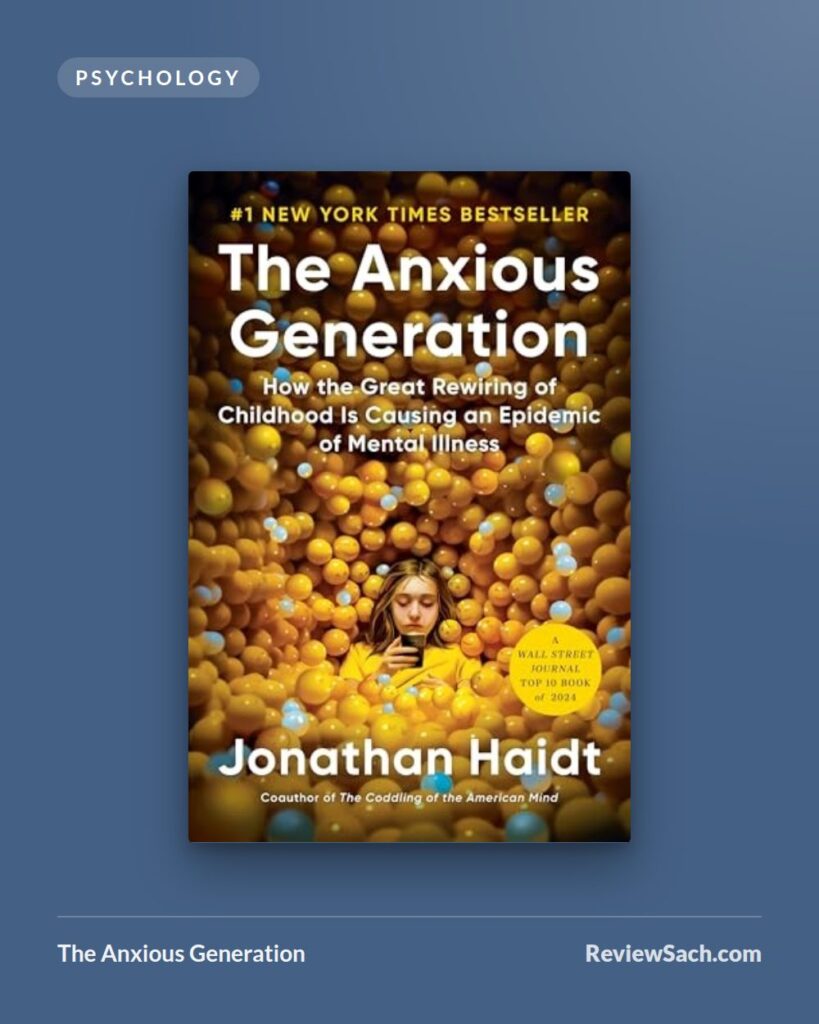
Author: Jonathan Haidt · Published: 2024 · Genre: Psychology, Parenting, Social Science
The Anxious Generation argues that the shift from a play-based to a phone-based childhood, concentrated between roughly 2010 and 2015, caused a sharp rise in teen anxiety, depression and self-harm. Haidt makes the case with energy and striking charts, and his proposed fixes are sensible whether or not he’s right about causation. But the central causal claim is disputed by serious researchers. Parents and teachers should read it, with the criticism in mind.
The big idea
Haidt calls it the Great Rewiring. In the early 2010s, smartphones with front-facing cameras, fast internet and image-heavy social media apps arrived in teenagers’ pockets. At the same time, he argues, parents in the US and other wealthy countries had spent two decades restricting kids’ unsupervised play out of fear of strangers and accidents. The result was overprotection in the real world and underprotection online.
He identifies four foundational harms: social deprivation, sleep deprivation, attention fragmentation and addiction. He then argues girls and boys are hurt differently. Girls are pulled into visual, comparison-driven social media. Boys drift into gaming and online worlds and withdraw from real-world challenge.
His solution is four new norms: no smartphones before high school, no social media before 16, phone-free schools, and far more independence and free play in the real world.
What works
- The fixes are concrete and achievable. Haidt’s key insight is that these are collective action problems. One parent withholding a phone isolates one child; a whole class or school doing it changes the norm. That framing is useful, and the book has fed into the wave of school phone bans.
- The play-based childhood section is strong. His argument that kids need risk, boredom and unsupervised time to become resilient is well grounded and often overlooked in the social media debate.
- It is readable and well organized. The charts are striking, the chapters are short, and each section ends with clear takeaways for parents, schools, tech companies and governments.
- The split between boys and girls adds nuance that many earlier alarm-bell books lacked.
The controversy
The book’s core claim, that social media caused the mental health decline, is where the fight is. Developmental psychologist Candice Odgers, reviewing it in Nature, argued that most studies find small or inconsistent links between social media use and mental health, that correlation is being mistaken for causation, and that struggling teens may turn to their phones more rather than the other way around. She also objected that talk of technology rewiring children’s brains runs ahead of the science. Other critics noted that trends differ across countries and that some of the rise in recorded problems may reflect changes in screening and reporting.
Haidt has responded at length. He points to experimental studies, to the timing of the decline appearing in several countries at once, and argues that no rival explanation fits the data as well. He also says parents can’t wait for perfect evidence while a generation grows up.
Both sides have a point. The correlations Haidt cites are real but mostly modest, and the experimental evidence is mixed. On the other hand, his precautionary argument is reasonable: delaying smartphones and freeing up play carries little risk even if social media turns out to be only one cause among several.
A smaller problem is tone. The book often writes as if the debate were settled, which it isn’t.
Who should read it
Parents of children under 14, teachers and school leaders will find it most useful, especially the practical chapters. Anyone who wants the full picture should also read Odgers’s review or similar critiques, since the book presents one side of a live scientific argument.
Rating: 3.5/5
Image credits — Cover image via Open Library. Cover design © the publisher, shown for review purposes.
