

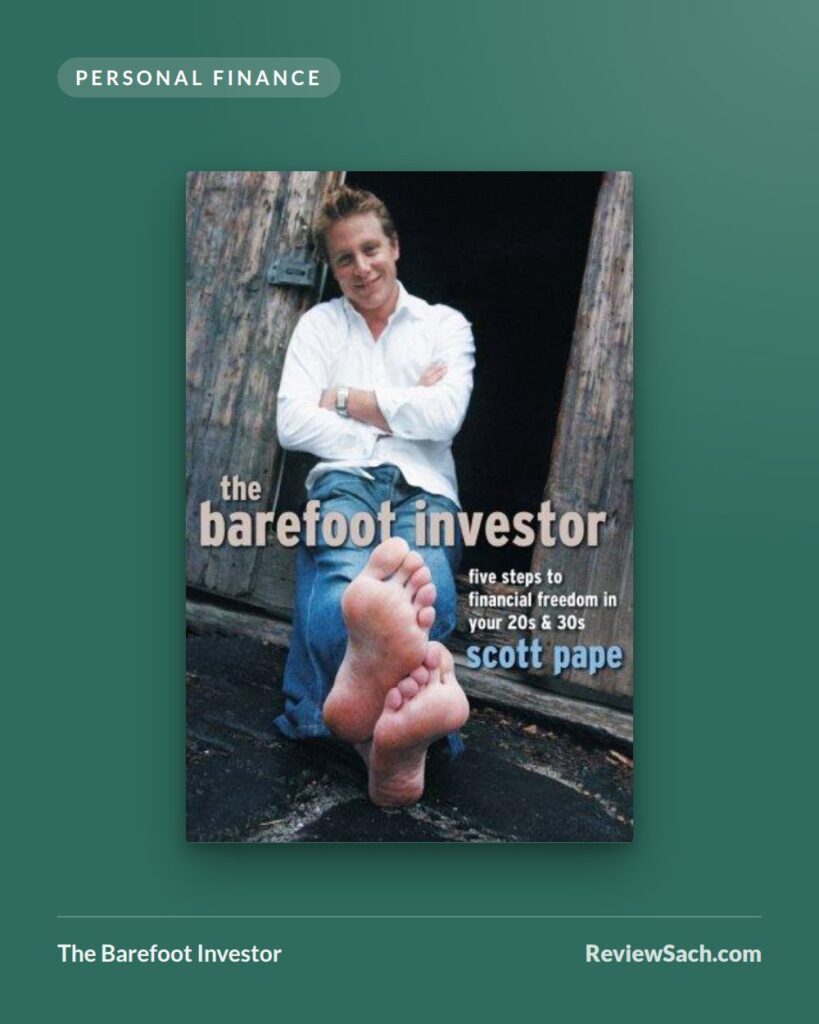
Author: Scott Pape · Published: 2016 · Genre: Personal Finance, Budgeting
The Barefoot Investor is the best simple money system for Australians: split your pay into a few bank accounts, kill your debts, fix your super and buy a home when you’re ready. It is folksy, specific and easy to act on. Readers outside Australia will still like the bucket idea, but much of the detail won’t apply to them.
The big idea
Scott Pape, a long-running Australian finance columnist, replaces the traditional budget with automated “buckets”. Your pay lands in a Blow bucket that is split across accounts: roughly 60% for daily expenses, 10% for Splurge (guilt-free fun), 10% for Smile (bigger goals such as a holiday) and 20% for the Fire Extinguisher, which puts out financial fires such as debt. A separate Mojo account holds an emergency buffer, starting at $2,000 and growing to several months of cover. Once that is in place, money flows into a Grow bucket for long-term wealth, mostly through superannuation and owning a home.
The book is organised as a series of Barefoot Steps. The first is a regular “Barefoot Date Night” to sit down and talk about money, with a partner or alone. Later steps cover dominoing your debts, sorting out your super, saving a home deposit and paying down the mortgage. The order matters: Pape wants a cash buffer and no consumer debt before any money goes into investing, and he treats owning the family home outright as a central goal rather than an optional extra.
Pape’s pitch is that none of this requires a finance degree or a high income. It requires setting things up once, then leaving them alone.
What works
- Systems beat willpower. Once the accounts are set up, the plan runs almost by itself. Readers don’t have to track every coffee or fill in a spreadsheet each week, which is why people actually stick with it.
- Permission to spend. The Splurge and Smile accounts make fun part of the plan rather than a failure of it. That removes the guilt that sinks most budgets within a month.
- Blunt advice on super. Pape walks readers through combining accounts, cutting fees and choosing a low-cost fund. It is dull material, but small fee differences compound into large sums over a working life, and he makes it painless.
- A warm voice. The tone is chatty and encouraging rather than preachy. Pape writes like a sensible friend, not a salesman, and he is clear that the goal is a calm, secure life rather than getting rich quickly.
What doesn’t
The book is deeply Australian. Super rules, tax settings and first-home schemes change regularly, so parts date quickly, and non-Australians have to translate almost everything. Pape also names specific banks and products, which is convenient for readers at the time but ages fast. Check any recommendation against the current market before acting on it.
His debt method pays off the smallest balance first for a quick psychological win. That works for many people, but it can cost more in interest than tackling the highest-rate debt first, and the book doesn’t dwell on that trade-off. The fixed percentages also assume a fairly steady income. People in expensive cities, or with irregular pay, may find that 60% for daily costs is simply not enough.
Some readers also find the hard line against credit cards and the relentlessly cheerful, homespun persona a bit much. The advice underneath is sensible and mainstream, but the packaging is very Pape.
Who should read it
Australians in their twenties to forties who feel disorganised with money, especially couples who argue about it. If you already automate your savings and understand your super, you’ll get less from it.
Rating: 4/5
Image credits — Cover image via Open Library. Cover design © the publisher, shown for review purposes.
