

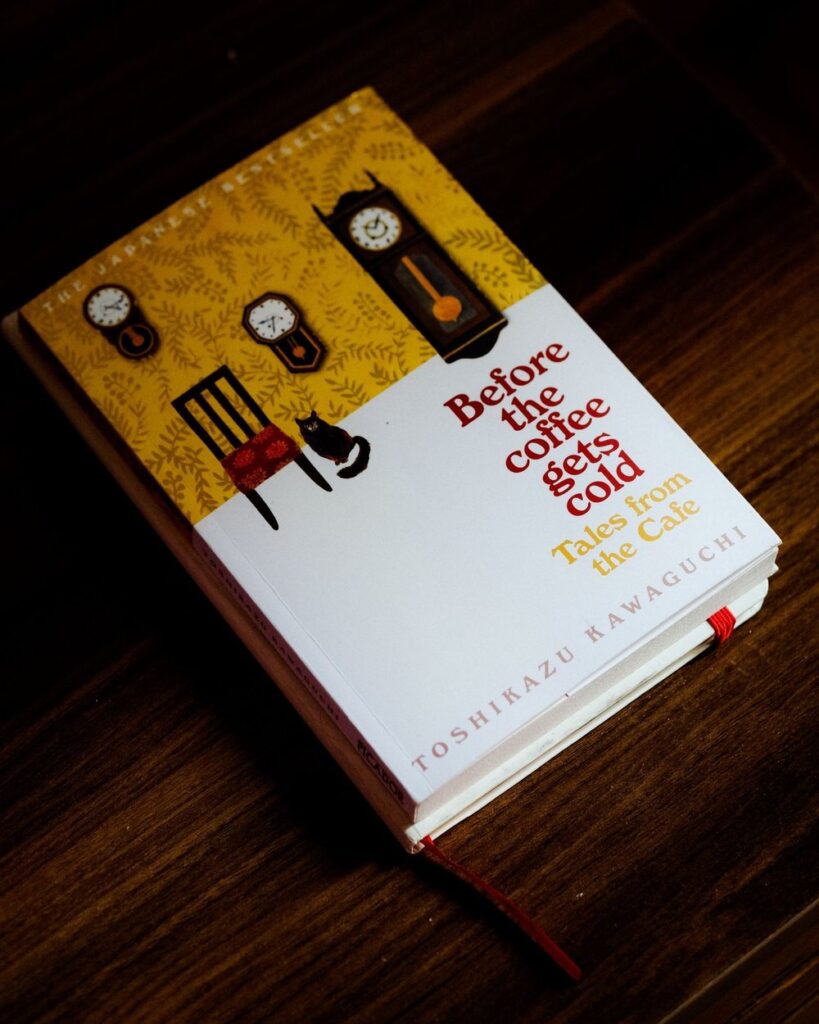
Author: Toshikazu Kawaguchi · Published: 2015 · Genre: Japanese Fiction, Magical Realism · Original title: Kōhī ga Samenai Uchi ni
Before the Coffee Gets Cold is a short, gentle book of linked stories about people who travel back in time in a Tokyo café to say something they never said. It’s warm and occasionally moving, but it spends a lot of time repeating its rules, and the characters are thinly drawn. A cozy weekend read, not a great novel.
What it’s about
Funiculi Funicula is a small basement café in Tokyo with one special seat. Sit in it, and Kazu, the waitress, will pour you a cup of coffee that sends you into the past. The rules are strict. You can only meet people who have visited the café. You can’t leave the seat. Nothing you do will change the present. The seat is usually taken by a ghostly woman in a dress, so you have to wait for her to get up. And you must drink the coffee before it gets cold, or you’ll be stuck as a ghost yourself.
Four stories follow four visitors: Fumiko, a businesswoman who wants another chance with the boyfriend who left for America; Kohtake, a nurse whose husband has Alzheimer’s; a bar owner who has been avoiding her younger sister; and Kei, the pregnant wife of the café’s owner, who has her own reasons for wanting to travel. The café’s owner, Nagare, a tall and quiet man, and his cousin Kazu link the stories, along with a few regulars who become familiar faces.
What works
- The premise. Because nothing can change the present, each trip is about changing the traveler: hearing a truth, making peace, saying goodbye. That’s a lovely constraint, and it turns time travel into a fable about acceptance.
- Emotional payoffs. The second story, about the nurse and her husband, and the last, about Kei, are genuinely touching. Kawaguchi is good at the quiet moment when someone finally understands another person.
- Setting. The windowless café, with its clocks that all show different times, is an appealing little world, and its regulars become familiar company.
- Everyday regrets. None of the regrets are dramatic. They are unspoken words, an unread letter, a sister kept at arm’s length, and that ordinariness makes them easy to recognize from your own life.
- Short and soothing. It reads in an evening, and its kindness is the appeal.
What doesn’t
Repetition. The book explains the rules again and again, sometimes within a few pages. That may come from its origins as a stage play, where the café was the only set, but on the page it drags.
The characters are sketches. The dialogue is often stiff and expository, with people telling each other things they already know. It’s hard to say how much of this comes from the English translation, by Geoffrey Trousselot, and how much from the original, but the prose is plain to the point of flatness.
The first story, Fumiko’s, is the weakest, and it sets expectations low. Some of its jokes about the café’s rules feel like sitcom beats, and the romance never convinces. Readers who give up early will miss the better stories that follow. And why the seat works at all is never explained, which suits a fable but may bother readers who want time travel to have some logic behind it.
Who should read it
Readers who want a comforting, low-stakes book, fans of Japanese “healing fiction”, and anyone drawn to stories about grief and second chances. It launched a series of sequels set in the same café and was adapted into a Japanese film in 2018. The sequels follow the same pattern, so if this one doesn’t click, the series won’t either. If you want rigor or depth, skip it.
Rating: 3/5
Photo credits — Featured image: Photo by Mathias Reding on Pexels.
