

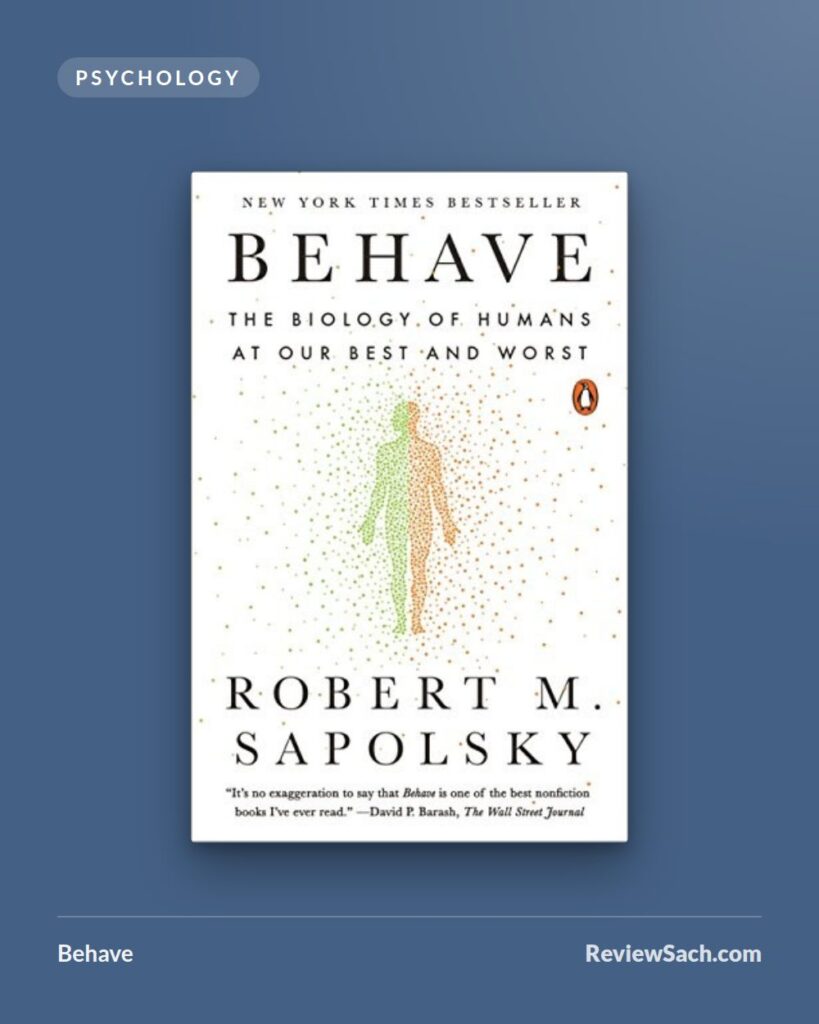
Author: Robert M. Sapolsky · Published: 2017 · Genre: Psychology, Neuroscience, Biology
Behave asks why a person did what they did, and answers by zooming out step by step from a single act to the whole of evolution. It is the best general book I know on the biology of human behavior: rigorous, funny and humane. It’s also long and dense, so it rewards patient readers far more than casual ones.
The big idea
Sapolsky’s structure is the book’s great trick. Take a behavior, good or bad, like pulling a trigger or touching someone’s arm. Then ask: what happened in the brain one second before? What sensory cues triggered that seconds to minutes earlier? What hormones were at work over the previous hours and days? And how did adolescence, childhood, life in the womb, genes, culture and millions of years of evolution shape the brain doing the acting?
Each chapter steps back one level in time. The amygdala, the frontal cortex, dopamine, testosterone, oxytocin, early stress and the ecologies that shaped different cultures all get their turn. The second half then applies the whole toolkit to big questions: us-versus-them thinking, hierarchy, morality, empathy, and war and peace.
His recurring message is that nothing has a single cause. Genes don’t determine behavior on their own, and neither do hormones or culture. Everything interacts, and the interactions depend on context. That’s why he distrusts anyone claiming to have found the gene, hormone or brain region for a complex behavior, a skepticism that runs through every chapter.
What works
- It kills simple stories. Sapolsky is excellent at taking a famous claim, such as that testosterone causes aggression or oxytocin makes us loving, and showing what the evidence actually says. Testosterone, he explains, tends to amplify whatever behavior earns status in a given setting rather than creating aggression from nothing. Oxytocin can make people warmer toward their own group and colder toward outsiders.
- The frontal cortex chapter is outstanding. His description of the frontal cortex as the part of the brain that pushes you to do the harder thing when it’s the right thing, and his explanation of how late it matures, is among the clearest in popular science. It changes how you think about teenagers.
- The humor keeps you going. The footnotes are full of asides and self-deprecating jokes, and the tone stays conversational despite the technical load. He clearly loves the material.
- It is morally serious. The later chapters on criminal justice and on reducing us-versus-them hostility show why the science matters outside the lab.
What doesn’t
At well over 700 pages, it’s a real commitment. The neuroscience chapters near the start are the hardest, and some readers will stall there. Sapolsky provides appendices on neuroscience, hormones and proteins for readers who need a primer, which helps but also shows how steep the climb is.
Some of the social-psychology findings of the kind the book relays, especially priming effects, have fared poorly in replication since it was published. Sapolsky often flags uncertainty, but a few studies are presented more confidently than they would be today.
The second half is looser than the first. Chapters on morality, empathy and war each cover huge literatures quickly and read more like essays than systematic reviews.
The argument against free will, which becomes explicit near the end, is more asserted than argued. Sapolsky devoted his follow-up, Determined, to making that case properly, and readers who find it unconvincing here won’t be alone.
Who should read it
Anyone serious about understanding human behavior from biology outward, including students, clinicians and curious general readers, should read it. If you want a quick overview, this isn’t it. If you want the real thing, this is the place to start.
Rating: 4.5/5
Image credits — Cover image via Open Library. Cover design © the publisher, shown for review purposes.
