

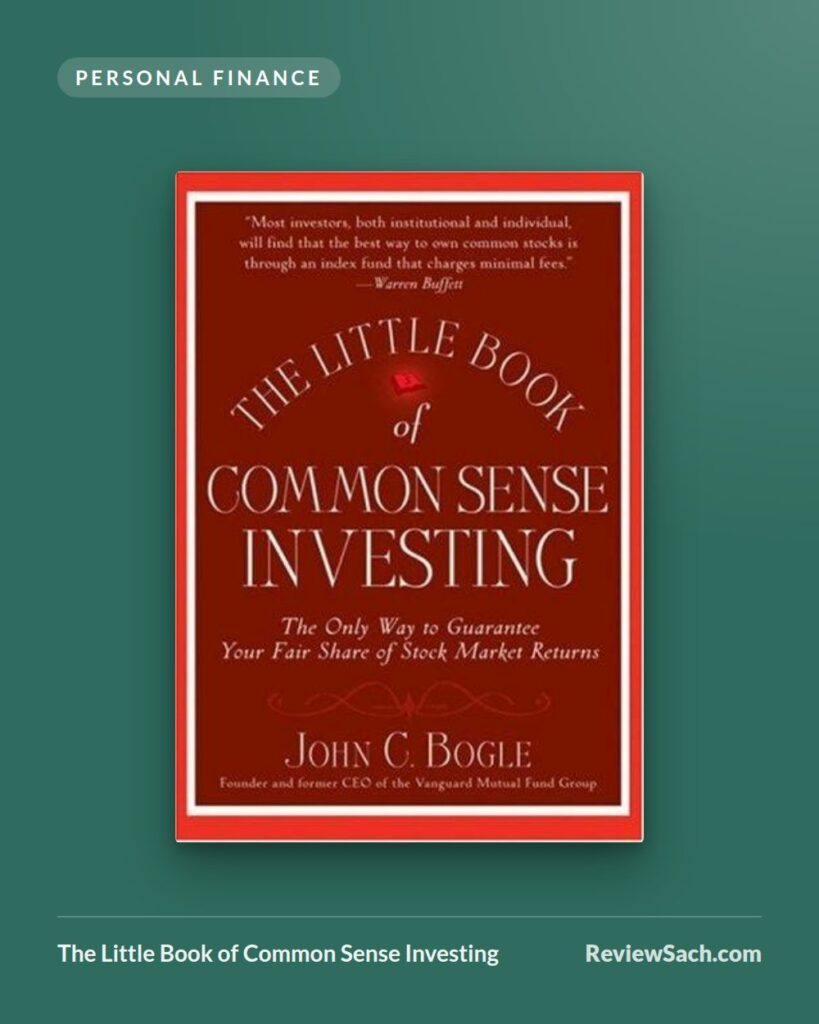
Author: John C. Bogle · Published: 2007 · Genre: Personal Finance, Investing
The Little Book of Common Sense Investing argues that the surest way for most people to earn good returns is to own the whole stock market through a low-cost index fund and hold it for decades. Bogle, who founded Vanguard and launched the first index mutual fund for ordinary investors in 1976, makes the case with simple arithmetic. It is short, persuasive and one of the few investing books nearly everyone should read, even if it repeats itself.
The big idea
The argument starts with what Bogle calls the relentless rules of humble arithmetic. Before costs, investors as a group earn the market’s return, because together they are the market. After costs, they must earn less. Every management fee, sales commission and trading cost comes out of investors’ pockets, so the average actively managed fund must trail an index fund that charges almost nothing.
From there, Bogle shows how small annual costs compound into large sums over decades, why funds that beat the market in one period rarely repeat the feat, and why chasing past performance backfires. He adds that frequent trading inside active funds creates tax bills on top of fees, a hidden cost most investors never notice. His summary advice is to stop searching for the needle and simply buy the haystack.
He also breaks stock returns into parts. Dividend yield plus earnings growth gives the investment return, while changes in valuation add or subtract a speculative return. Over long periods the investment return dominates, so investors should focus on the business fundamentals rather than on market mood.
What works
- The logic is airtight. The cost argument doesn’t depend on forecasts or theory; it is arithmetic. Once you see it, it is hard to unsee, and it applies in any country with a stock market.
- Costs made vivid. Bogle’s comparisons of a low-cost index fund with a typical managed fund over a working lifetime make fee differences that look trivial in a single year suddenly look enormous.
- Investors versus their funds. He shows that fund investors often earn less than the funds they own, because they pile in after good runs and bail out after bad ones. It is a sharp, humbling point about behaviour.
- Authority. Bogle built the index-fund industry and spent decades fighting high fees, often against fierce ridicule from the rest of Wall Street. The book carries the conviction of someone who was right early.
What doesn’t
The book is repetitive. The same argument about costs appears chapter after chapter, sometimes with the same examples. Short as it is, it could be shorter still, and readers already convinced by the cost argument will be skimming by the halfway point.
Bogle is also partial. His praise of Vanguard and traditional index funds is sincere but hardly neutral. He was sceptical of exchange-traded funds, arguing that easy intraday trading tempts investors to speculate, even though many ETFs are simply cheap index funds that people buy and hold for years.
His view on international stocks is debatable. Bogle felt American investors didn’t need much foreign exposure, since large US companies already earn money worldwide. Many index advocates disagree and treat global diversification as basic risk management, especially for readers outside the US.
Finally, the examples are for US readers. Account types and fund names need translating elsewhere, although the core arithmetic travels perfectly. A tenth-anniversary edition in 2017 updated the data.
Who should read it
Anyone with a retirement account, and anyone paying for active fund management without knowing why. If you only read one book on investing, this is a strong candidate, ideally paired with a book on saving and spending habits.
Rating: 4.5/5
Image credits — Cover image via Open Library. Cover design © the publisher, shown for review purposes.
