

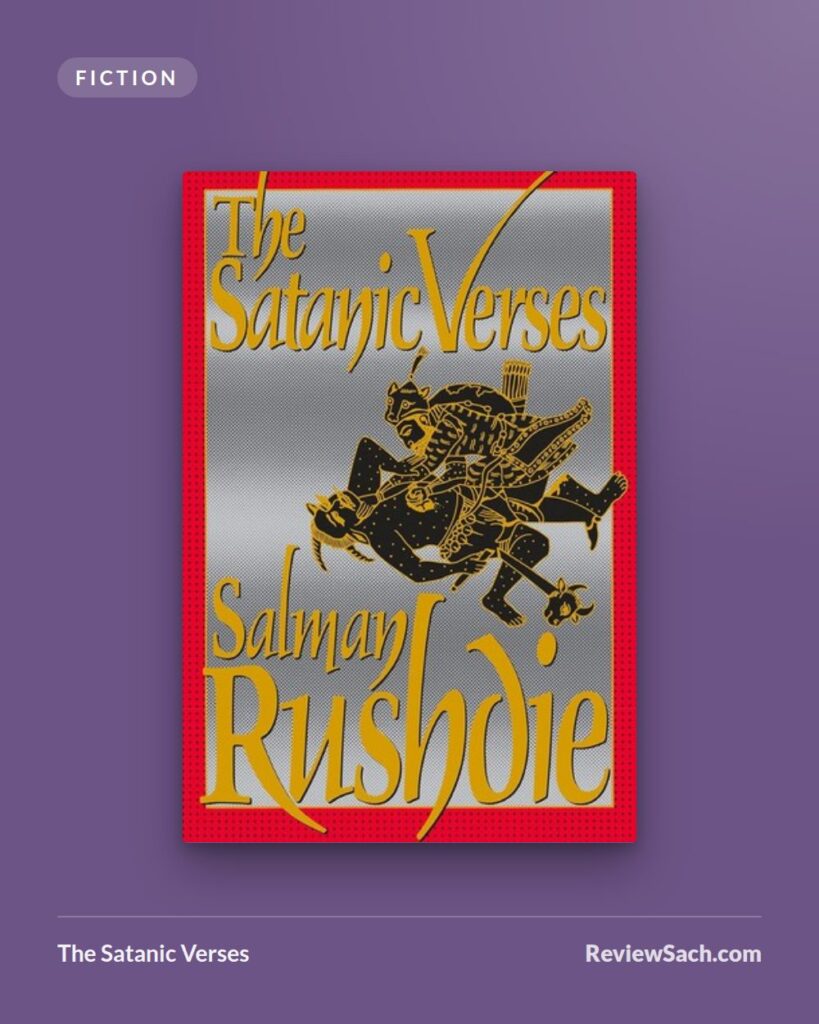
Author: Salman Rushdie · Published: 1988 · Genre: Literary fiction, Magical realism
The Satanic Verses is a big, restless novel about migration, identity and faith, told through two Indian actors who survive a fall from the sky. It is brilliant in places, funny in many and tiring in long stretches. Most people know it only for the fatwa it provoked. It’s worth reading for committed literary readers, but it’s not the best way into Rushdie.
What it’s about
A hijacked jumbo jet explodes over the English Channel. Two passengers fall out of the sky and survive. Gibreel Farishta is a hugely popular Bombay film star famous for playing gods. Saladin Chamcha is an Anglophile voice actor who has spent his life trying to become English. After they land, Gibreel starts to take on the look of an angel, while Chamcha slowly turns into a horned, goat-like devil.
Their story in London is interrupted by Gibreel’s dreams. The best known follows Mahound, a businessman turned prophet in the desert city of Jahilia, who is tempted to accept a compromise with the city’s goddesses. Other dreams follow an imam in exile and a young woman named Ayesha who leads a village on a pilgrimage to the sea.
What works
- The energy. Rushdie’s sentences are packed with puns, Bombay slang, film references and jokes. Few novelists have this much fun with English.
- The migrant story. Chamcha’s transformation is a sharp satire of how Britain treated South Asian immigrants in the 1980s. Being turned into a monster by the way others see you is a strong image, and the scenes with the police are angry and pointed.
- The questions about faith. The Mahound chapters draw on a story found in some early Islamic histories, and rejected by many Muslim scholars, in which a prophet briefly accepts verses praising three local goddesses before renouncing them as the devil’s work. Rushdie uses it to ask how anyone can tell a true revelation from a false one.
The controversy
Many Muslims saw the Mahound sections as a deeply offensive portrait of the Prophet Muhammad, especially a sequence in which prostitutes in a Jahilia brothel take the names of the prophet’s wives. India banned the book’s import within weeks of publication. Copies were burned in Bradford, England, and protests in Pakistan turned deadly. On 14 February 1989, Iran’s Ayatollah Khomeini issued a fatwa calling for the death of Rushdie and of those involved in publishing the book who knew its contents.
Rushdie spent years in hiding under police protection. His Japanese translator, Hitoshi Igarashi, was murdered in 1991, and other translators and a publisher were attacked. In 2022 Rushdie was stabbed on stage at a literary event in New York State and lost the sight in one eye.
Defenders of the book argue that the offending chapters are the dreams of a man losing his mind, that fiction must be free to question religion, and that no novel justifies violence. Critics reply that the book is not neutral and that the hurt felt by many believers was real, not manufactured. Both things can be true at once: the offense was sincere, and a novel is not grounds for murder.
Set the scandal aside and the book still has problems. It is long and digressive, the London chapters sag, and the dream sections can feel like separate novels stitched together. Many readers never make it to the end.
Who should read it
Readers who enjoy big, digressive novels, and anyone who wants to judge the book on its own terms rather than by its reputation. If you’re new to Rushdie, start with Midnight’s Children, which is more focused and more rewarding.
Rating: 3.5/5
Image credits — Cover image via Open Library. Cover design © the publisher, shown for review purposes.
