

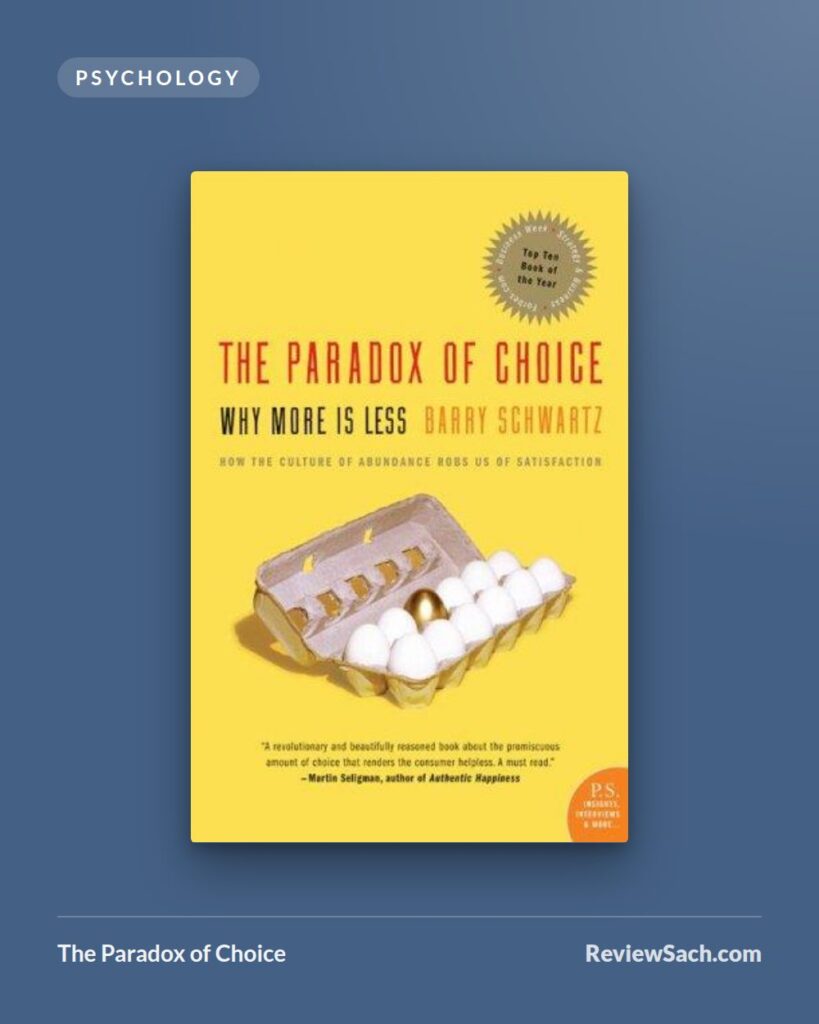
Author: Barry Schwartz · Published: 2004 · Genre: Psychology, Behavioral Economics
The Paradox of Choice argues that beyond a certain point, more choice makes us less happy rather than more free. Schwartz’s advice on how to choose, especially his distinction between maximizers and satisficers, is genuinely useful. But the famous research on choice overload has proved less robust than the book implies. It’s still worth reading for anyone who agonizes over decisions, big or small.
The big idea
Schwartz opens with a shopping trip for jeans. He wants a pair like the ones he’s always bought and is confronted with a bewildering range of fits and finishes. He ends up with better jeans and feels worse about it.
That’s the paradox. Choice is good up to a point, since having none is miserable. But as options multiply, the costs rise: more time and effort to decide, more regret about the options we passed up, higher expectations, and more self-blame when things disappoint.
His central distinction is between maximizers, who seek the best possible option, and satisficers, a term from the economist Herbert Simon, who settle on the first option that’s good enough. Schwartz argues that maximizers may do better on paper but feel worse, and his own surveys linked maximizing to lower satisfaction, more regret and more symptoms of depression.
The final part offers practical steps: choose when to choose, satisfice more, worry less about the options you gave up, make decisions final, practice gratitude, and expect to adapt to whatever you pick.
What works
- The maximizer and satisficer idea is the book’s lasting contribution. It’s simple, recognizable and useful. Many readers will immediately see themselves, and the advice to satisfice in areas that don’t matter much is freeing.
- The analysis of regret and adaptation is sharp. Schwartz explains how quickly we get used to good things, so the pleasure of a carefully chosen purchase fades while the effort and second-guessing remain.
- The practical advice is sensible. Making some decisions final, for example, cuts down on second-guessing, and Schwartz cites research suggesting people are often happier with choices they can’t reverse.
- It goes beyond shopping. Schwartz shows the same dynamic in health care, where patients are increasingly asked to pick among treatments, and in college, where students face vast menus of courses.
The controversy
The book’s most famous evidence is the jam study by Sheena Iyengar and Mark Lepper. Shoppers who passed a display of 24 jams were more likely to stop, but far less likely to buy, than those who saw six. It became a staple of business books and talks, including Schwartz’s own widely viewed TED talk.
Later research complicated the story. A 2010 meta-analysis led by Benjamin Scheibehenne found that, across many studies, the average effect of choice overload was close to zero, with some studies finding that more choice actually helped. A 2015 meta-analysis by Alexander Chernev and colleagues then argued that choice overload does occur, but mainly under specific conditions, such as when options are hard to compare or people have no clear preferences.
The fair summary is that too much choice can hurt in some situations, but it isn’t the general law the book sometimes implies. Schwartz’s link between rising choice and rising depression in wealthy countries is also speculative.
The examples, from phone plans to retirement investments, date the book too. Online shopping, reviews and recommendation algorithms have changed how most people choose.
Who should read it
Chronic deliberators, perfectionists and anyone who spends too long comparing products will find the advice helpful. Readers interested in behavioral science should pair it with the later research on when choice overload does and doesn’t occur.
Rating: 3.5/5
Image credits — Cover image via Open Library. Cover design © the publisher, shown for review purposes.
