

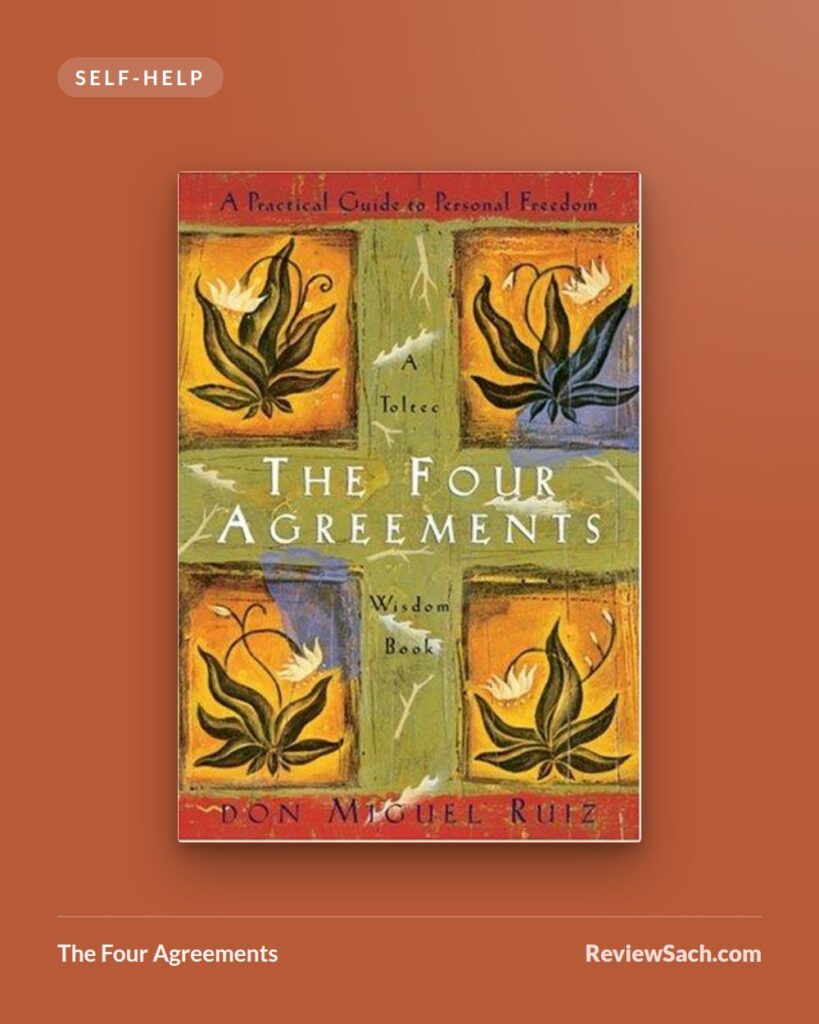
Author: Don Miguel Ruiz · Published: 1997 · Genre: Self-Help, Spirituality
The Four Agreements argues that we suffer because of beliefs we absorbed as children, and that four new commitments can free us: be impeccable with your word, don’t take anything personally, don’t make assumptions, and always do your best. It’s short, clear and genuinely helpful for people who are hard on themselves or quick to take offense. But it presents a mystical worldview as fact, and some of its rules work better as ideals than as instructions.
The big idea
Ruiz, a Mexican writer who trained as a surgeon before turning to his family’s spiritual traditions, frames the book as ancient Toltec wisdom. He describes the world we perceive as a dream shaped by what he calls domestication. As children, we’re rewarded and punished until we accept society’s beliefs about who we should be. Those beliefs become an inner Book of Law, enforced by an inner Judge and suffered by an inner Victim. Most of our pain, he says, comes from punishing ourselves again and again for the same mistake.
The four agreements are meant to replace those old, fear-based ones:
- Be impeccable with your word. Speak with integrity, say only what you mean, and don’t use words against yourself or to gossip about others.
- Don’t take anything personally. What others say and do is a projection of their own reality, not a verdict on you.
- Don’t make assumptions. Ask questions, and say clearly what you want, instead of guessing and then reacting to your guesses.
- Always do your best. Your best changes with circumstances, and doing it prevents self-judgment and regret.
Ruiz admits you’ll break these agreements often. His advice is not to judge yourself when you do, but simply to start again, trusting that each attempt makes the next one easier.
What works
- It’s memorable. Four rules are easy to recall in a tense moment, which is exactly where most self-help fails.
- The last agreement is kind. By saying your best varies from day to day, whether you’re sick, tired or rested, Ruiz sets a standard that’s demanding without being perfectionist. It balances the other three, which could otherwise become a new stick to beat yourself with.
- Assumptions. The chapter on how we fill gaps with stories and then react to them lines up with what therapists call mind-reading. It’s practical for couples, families and coworkers.
- Length. You can read it in an afternoon and reread it often, and many readers keep it on a nightstand for exactly that reason.
What doesn’t
The Toltec framing is more branding than history. The Toltecs were a real pre-Columbian culture, but little is known about their spiritual teachings, and the book’s ideas look more like a blend of New Age thought, Buddhist-style detachment and Ruiz’s own family tradition. It’s best read as one teacher’s philosophy, not recovered ancient knowledge.
Some advice is too absolute. Never taking anything personally can slide into ignoring fair criticism, and the book says little about how to tell a projection from useful feedback. Being impeccable with your word is an admirable ideal, but the book offers few practical steps for getting there.
The worldview, with its talk of dreams, a parasite in the mind and heaven on earth, will put off many secular readers. And its claims about why people suffer are asserted rather than supported by any evidence. The follow-up, The Fifth Agreement, written with his son Don Jose Ruiz, adds a fifth rule: be skeptical, but learn to listen. It answers some of these concerns.
Who should read it
Read it if you replay arguments, take offense easily or talk to yourself harshly. Skeptics can still use the four rules and skip the metaphysics.
Rating: 3.5/5
Image credits — Cover image via Open Library. Cover design © the publisher, shown for review purposes.
