

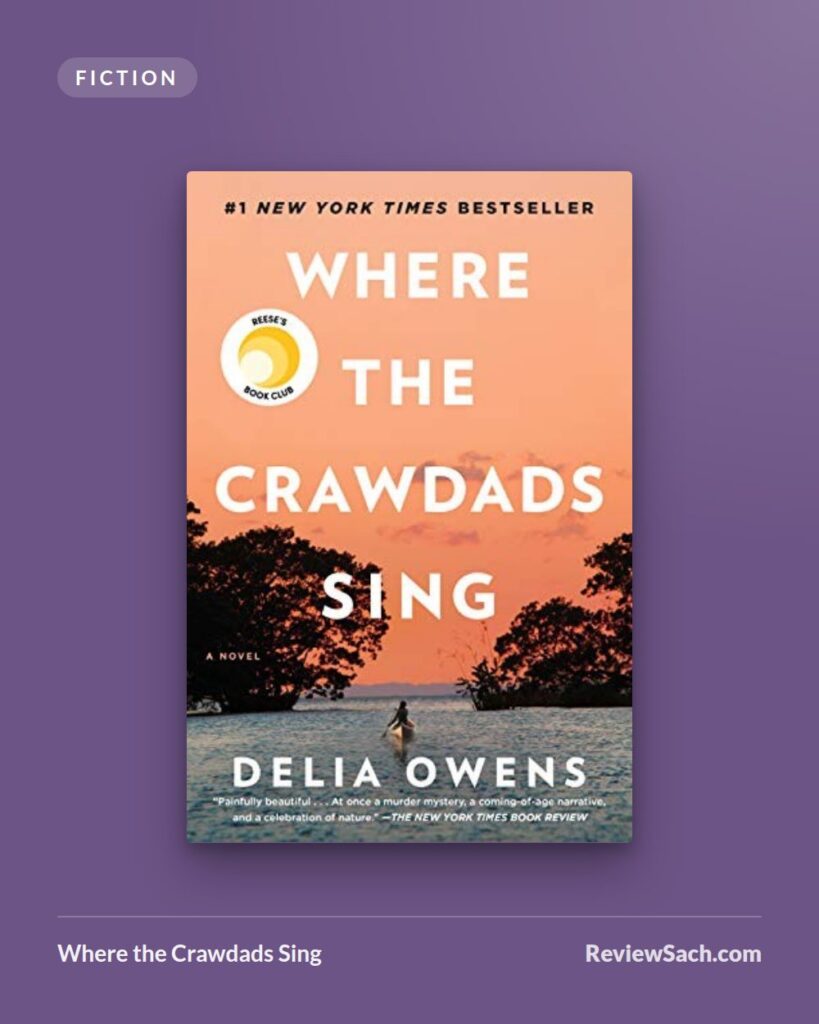
Author: Delia Owens · Published: 2018 · Genre: Literary Fiction, Coming-of-Age, Mystery
Where the Crawdads Sing is at its best as a nature-soaked survival story about a girl raising herself in the North Carolina marshes, and at its weakest as the murder mystery it also wants to be. It’s absorbing and easy to love, which explains its enormous sales, but it asks for a lot of suspended disbelief. Read it for the setting; don’t expect a tightly built crime novel.
What it’s about
The book runs on two timelines. In 1952, six-year-old Kya Clark watches her mother walk away from their shack in the marsh outside Barkley Cove, a fictional coastal town. Her older siblings leave too, and in time her violent, drunken father disappears. Kya survives alone, selling mussels to Jumpin’, a Black man who runs a small fuel dock, and his wife Mabel, who quietly look out for her. The townspeople call her the “Marsh Girl”.
In 1969, Chase Andrews, the town’s former star quarterback, is found dead beneath an old fire tower, and suspicion falls on Kya. Between those threads, a local boy, Tate Walker, teaches her to read, Kya grows into a self-taught naturalist, and Chase later pursues her. The title is a phrase Kya’s mother used for the far, wild reaches of the marsh, where animals still behave like animals.
What works
- The marsh. Owens trained as a wildlife scientist, and it shows. Her descriptions of herons, fireflies, tides and gulls are precise and genuinely lovely. Kya’s habit of reading human behavior through animal behavior, from courtship displays to territorial fights, gives the book its most interesting ideas.
- Kya’s loneliness. The early chapters, where a small child learns to cook grits, run a boat and hide from the truant officer, are moving without tipping into sentimentality.
- The feather courtship. Tate’s first approach, leaving rare feathers on a stump for Kya to find, is a lovely image of how you win the trust of something wild.
- Momentum. Short chapters and the alternating timelines make it hard to put down, even when you doubt what’s happening.
What doesn’t
The mystery and courtroom sections are the weakest writing in the book. Plausibility strains throughout: an abandoned child who becomes a published expert, a town that barely intervenes, a first romance that reads like young-adult fiction. Many critics also found the ending too neat, and some argued that it undercuts much of what came before. I won’t say more.
Some readers have criticized the portrayal of Jumpin’ and Mabel as saintly helpers whose main role is to serve a white heroine, and the Southern dialect as heavy-handed. The men who threaten Kya are also drawn in simple strokes, which makes the book’s moral questions easier than they should be.
The controversy
Owens’ own past has shadowed the book. In the 1990s she and her then-husband, Mark Owens, ran an anti-poaching project in Zambia’s North Luangwa National Park. A 1996 ABC News program about their work showed the shooting of an alleged poacher. In 2022, a long report by Jeffrey Goldberg in The Atlantic said Zambian authorities still wanted to question Delia, Mark and Mark’s son, Christopher, about the killing. None of them has been charged with a crime, and the Owenses have denied wrongdoing. Some readers see uncomfortable echoes of that history in the novel’s plot, but that is interpretation, not established fact, and it’s fair to judge the book on its own terms.
Who should read it
It was a Reese Witherspoon book club pick in 2018, and that audience is the right one: book-club readers, nature lovers and fans of Southern coming-of-age stories will get plenty from it. If you mainly want a clever mystery, pick a dedicated crime novel instead. The 2022 film follows the plot closely but can’t reproduce the best part: Owens’ writing about the natural world.
Rating: 3.5/5
Image credits — Cover image via Open Library. Cover design © the publisher, shown for review purposes.
