

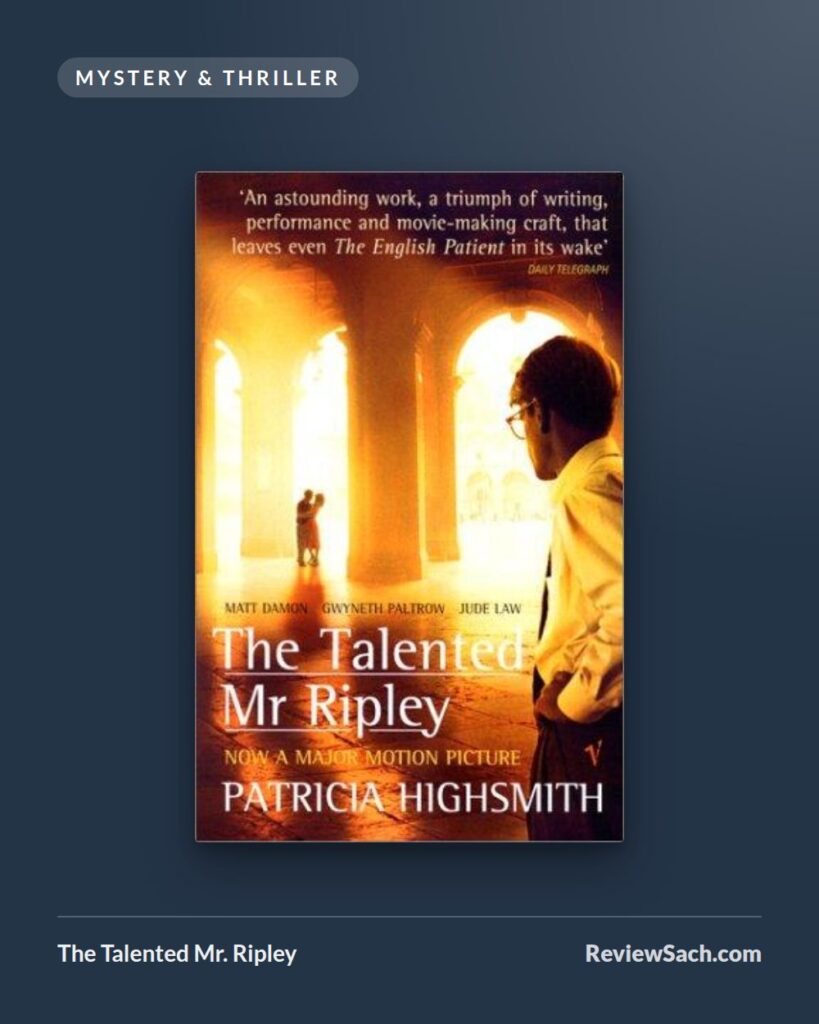
Author: Patricia Highsmith · Published: 1955 · Genre: Psychological Thriller, Crime Fiction
The Talented Mr. Ripley is a crime novel told from inside the head of a con man, and its nasty genius is that it makes you want him to succeed. It is a slow, sun-soaked study of envy and identity rather than a puzzle. Read it if you like psychological suspense and can manage without a moral anchor.
What it’s about Tom Ripley is a young man in New York scraping by on small scams and a talent for imitation. One day Herbert Greenleaf, a wealthy shipbuilder, mistakes him for a close friend of his son, Dickie, and makes an offer: go to Italy, all expenses paid, and persuade Dickie to come home and join the family business.
Dickie is living in Mongibello, a fictional coastal village south of Naples, painting without much talent and enjoying his trust-fund freedom, with his friend Marge Sherwood nearby. Tom arrives and slides into Dickie’s life, studying his clothes, his voice and his habits. His gift for mimicry begins as a party trick. Envy turns into obsession, and when Dickie begins to tire of him, Tom’s talents turn dangerous. From there the novel follows Tom’s efforts to keep his lies intact as friends, family and the Italian police start asking questions.
What works – Complicity. Highsmith writes in close third person, so we share Tom’s calculations, his panics and his relief. Before long you are holding your breath on his behalf, and then feeling uneasy about it. That is the book’s real achievement. – Tom himself. He is not a cartoon psychopath. He is insecure, snobbish, funny and hungry for the beauty and ease that money buys. His longing for Dickie’s life, and his ambiguous feelings for Dickie himself, make him disturbingly understandable. – Restraint. Highsmith never explains Tom or excuses him. There is no psychiatrist’s diagnosis and no moral from the narrator, only behaviour, and that restraint makes him more frightening than any lecture could. – Suspense without mystery. There is no whodunit, only near-misses: a friend who drops by at the wrong moment, a letter that says too much, a detective’s polite questions. Highsmith wrings enormous tension from small, ordinary encounters. – Italy. The postwar settings, from Mongibello to Rome and Venice, are vivid and seductive. That is the point: this is the life Tom wants, and Highsmith makes you understand why.
What doesn’t The pace is slow, particularly in the first third, and Highsmith’s prose is plain rather than beautiful. Other characters exist mostly as obstacles or marks. Marge in particular is written with a contempt that belongs to Tom but sometimes seems to be shared by the novel. The police are fairly credulous, and the plot leans on luck at several key moments, which weakens the sense of Tom as a genius.
The book’s sexual subtext has also drawn debate. Tom’s fixation on Dickie, and his anxiety about being seen as gay, are central to his character. Some readers feel the book reinforces an old link between queerness and criminality. Others, noting that Highsmith was herself a lesbian writing in the 1950s, read it as a sharp portrait of repression and self-invention in a hostile era. Both readings are defensible, and the ambiguity is part of what keeps the novel alive.
Who should read it Fans of psychological suspense and anti-heroes, and anyone who enjoyed Anthony Minghella’s 1999 film with Matt Damon or the 2024 series Ripley with Andrew Scott. The novel is colder and stranger than either, so read it first if you can. If you need a sympathetic protagonist or a sense of justice, this will leave you chilled, which is exactly what Highsmith intended.
Rating: 4.5/5
Image credits — Cover image via Open Library. Cover design © the publisher, shown for review purposes.
