

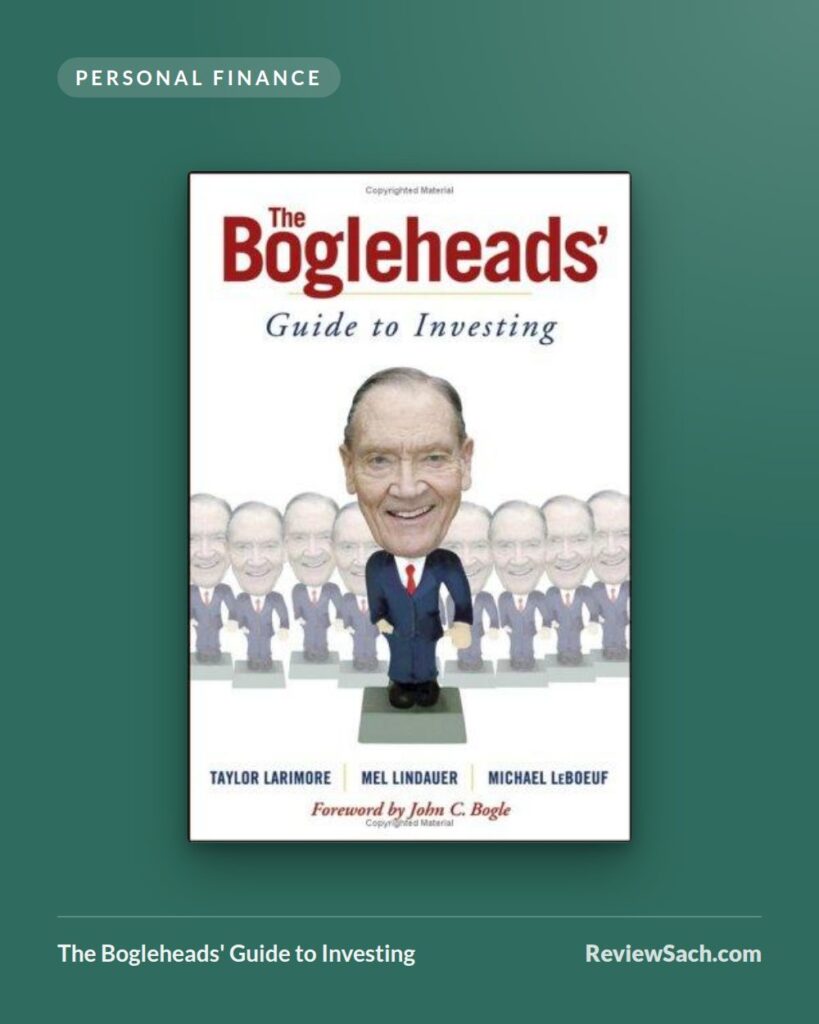
Author: Taylor Larimore, Mel Lindauer and Michael LeBoeuf · Published: 2006 · Genre: Investing, Personal Finance
The Bogleheads’ Guide to Investing is the clearest complete manual on low-cost index investing for American savers. Written by leading members of the online community inspired by Vanguard founder John Bogle, it explains why simple, cheap, diversified portfolios beat most alternatives, then shows step by step how to build and keep one. It is thorough and trustworthy, if dry and repetitive.
The big idea
The book turns Bogle’s philosophy into a do-it-yourself plan. Its principles are simple: live below your means, start early and invest regularly, understand what you own, keep costs and taxes low, diversify, choose an asset allocation that fits your goals and tolerance for risk, rebalance, ignore market noise and stay the course.
The authors were long-time regulars on an online forum of Bogle followers, originally hosted on Morningstar’s website, and the book distils years of that community’s discussions into one volume. Bogle himself wrote the foreword. The core message is that investors can’t control returns, but they can control costs, taxes and their own behaviour, and those three things decide most outcomes.
Simplicity runs through every chapter. A handful of broad index funds covering the US stock market, international stocks and bonds is presented as enough for most people. Larimore later expanded that idea into a separate book on the three-fund portfolio.
What works
- Costs explained properly. The book shows how expense ratios, sales loads, trading costs and taxes compound against investors over decades, and why index funds win by default rather than by brilliance. The arithmetic is simple, and the authors make sure readers see it.
- Practical scope. Beyond investing, it covers emergency funds, debt, insurance, college savings and inflation-protected bonds. It also explains which investments are better held in taxable accounts and which in tax-advantaged ones, a topic many beginner books skip.
- Behaviour. Chapters on market timing, chasing last year’s winners and tuning out financial media are a strong cure for the urge to react to headlines. The authors argue, convincingly, that the investor is often the biggest risk to the portfolio.
- Stay the course. The closing message, borrowed from Bogle, is to pick a sensible plan and stick with it through booms and crashes. It sounds obvious, but the book explains why it is so hard in practice.
- Honesty. The authors don’t promise to beat the market. They promise to capture most of its return at low cost, which is achievable, and they are open about the trade-offs of each choice.
What doesn’t
It is very American. Details about 401(k)s, IRAs, US tax rules and particular funds mean readers elsewhere have to translate almost everything. Specifics such as contribution limits and fund options have also dated since 2006; a second edition in 2014 refreshed much of it, and readers should pick up that version.
The style is plain and repetitive, sometimes more like a collection of forum threads than a single argument, and the same points about costs and discipline come round several times. The asset allocation guidance leans on simple rules of thumb, such as holding roughly your age in bonds, which some investors now consider too cautious for young savers with decades ahead of them.
Readers wanting depth on newer debates, such as factor tilts, how much to hold abroad or how to draw down savings in retirement, won’t find much here. It is a foundation, not an advanced text.
Who should read it
US investors who want one book to set up and maintain a sensible, low-maintenance portfolio. If you already own a simple three-fund portfolio and understand why, you have absorbed the message.
Rating: 4/5
Image credits — Cover image via Open Library. Cover design © the publisher, shown for review purposes.
