

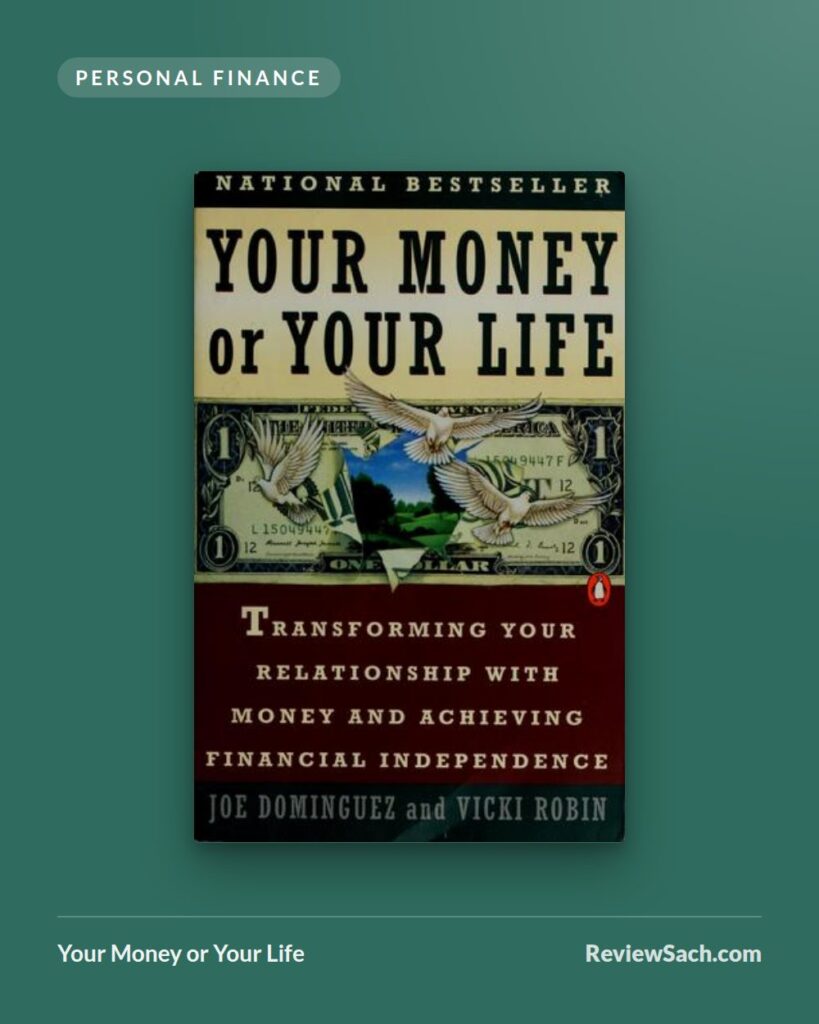
Author: Vicki Robin and Joe Dominguez · Published: 1992 · Genre: Personal Finance, Financial Independence
Your Money or Your Life argues that money is something you trade your life energy for, so every purchase should be judged by the hours of life it costs. That simple reframe powers a nine-step programme for spending consciously and, eventually, reaching financial independence. It is an intellectual root of the modern FIRE movement and still well worth reading, though its original investment chapter has aged badly.
The big idea
The authors ask you to calculate your real hourly wage. Start with your pay, then subtract the hidden costs of having a job: commuting, work clothes, convenience food bought because you’re tired, the breaks you need to recover. Add the hours those things consume. The result is usually far lower than your nominal wage, and it becomes the exchange rate for everything you buy. A new gadget stops costing a sum of money and starts costing a number of hours of your life.
From there the steps build. You total everything you have earned in your life and compare it with what you have to show for it. You track every penny coming in and going out, then sort it into categories each month. For each category you ask whether the spending brought fulfilment in proportion to the life energy it cost, and whether it fits your values. You plot income, expenses and investment income on a large wall chart. Eventually the investment-income line crosses the expenses line, and at that crossover point, paid work becomes optional. Along the way, the programme also covers raising income, framed as being fairly paid for your life energy rather than chasing status.
What works
- No budget, no shame. The book rejects both budgeting and guilt. You are not told what to cut; you notice what doesn’t bring fulfilment, and it tends to fall away. That makes the approach gentler and more durable than most frugality advice.
- The idea of enough. The authors’ fulfilment curve, where spending beyond a certain point adds clutter rather than satisfaction, is a clear way to think about lifestyle inflation.
- The crossover chart. Watching the lines converge turns a vague goal into a visible one, a strong motivator over years.
- Values first. Unlike get-rich books, this one treats money as a tool for a meaningful life, with time for family, community and service.
What doesn’t
The original investment advice was to put savings into long-term US Treasury bonds and live on the interest. That worked with the high interest rates of the era but became unworkable once rates fell, and it gave too little weight to inflation. The 2018 edition, revised by Robin after Dominguez’s death in 1997 and carrying a foreword by the blogger Mr. Money Mustache, replaces it with a broader discussion of options including index funds. That section is still muddier than the rest of the book.
The tracking is also demanding. Recording every penny and doing monthly tabulations for years is a lot to ask, and many readers will give up before the crossover chart gets interesting. Apps can automate some of the work today, but the book’s method assumes pen, paper and patience.
The tone, with its talk of life energy and the planet, will suit some readers and put others off. And the programme assumes you have room to cut. For people on low incomes, where rent and essentials swallow most of the pay, questions about fulfilment matter less than hard arithmetic.
Who should read it
Anyone who feels stuck on a treadmill of earning and spending, and anyone curious about financial independence. Read the 2018 edition, take the early steps seriously, and get your investment advice from a more focused source.
Rating: 4/5
Image credits — Cover image via Open Library. Cover design © the publisher, shown for review purposes.
