

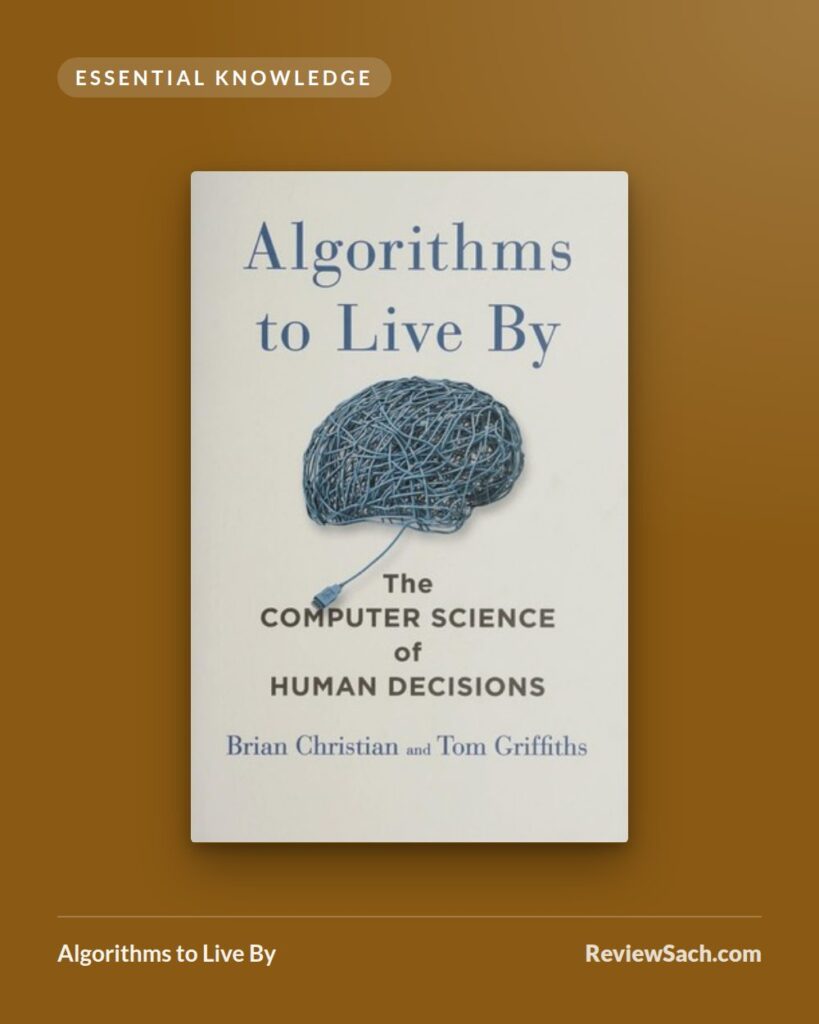
Author: Brian Christian and Tom Griffiths · Published: 2016 · Genre: Popular Science, Decision Making
Algorithms to Live By‘s biggest strength is that it makes real computer science vivid and gives you genuinely new ways to think about ordinary problems, from house-hunting to a messy desk. Its weakness is an uneven practical payoff: some chapters are elegant ideas with little you can actually use, and the analogies get looser as the book goes on. Read it if you are curious about how computers solve problems and like your self-help with some mathematics in it.

The big idea
Christian is a writer on technology and philosophy; Griffiths is a cognitive scientist who studies human reasoning. Their argument, set out in eleven chapters, is that many everyday dilemmas, such as when to stop looking, what to keep and what to do first, are the same problems computer scientists have studied for decades. Their solutions can guide us, or at least reassure us when a problem has no perfect answer. The highlights:
- Optimal stopping. The 37% rule: if you must judge a known number of options one at a time and can’t go back, such as apartments or job candidates, spend the first 37% looking without committing, then take the first option better than everything you have seen. It finds the very best option about 37% of the time, which is the best any strategy can do.
- Explore or exploit. Should you try the new restaurant or return to your favourite? It depends on how much time you have left: explore early, exploit later. The authors use this to reframe why older people tend to prefer smaller circles of close friends.
- Caching. Keep what you used most recently close at hand. A pile of papers on your desk, with the latest on top, turns out to be a surprisingly efficient system.
- Scheduling. There is no single best way to order your tasks; the right rule depends on what you want. To minimise the worst lateness, work in order of due date. To clear the most tasks quickly, do the shortest first. Constant switching between tasks leads to “thrashing”, where you are so busy changing jobs that nothing gets done.
- And more: Bayesian prediction from little data, why simpler models often beat complex ones (overfitting), when randomness helps, how networks back off under congestion, and game theory.
What’s great
The science is real, not decorative. Griffiths is a working researcher, and the book explains the actual results, their assumptions and their limits, without equations. The stories are excellent, including the priority inversion bug that troubled NASA’s Mars Pathfinder mission, a lesson in how a low-priority task can block a critical one.
The book’s best idea is humane. Since many problems are intractable even for computers, it argues, you should judge decisions by the process you followed, not the outcome you got. Its notion of “computational kindness”, such as proposing a specific meeting time instead of asking an open-ended “when are you free?”, is a small, genuinely useful habit.
What’s weak
The practical takeaways are thinner than the subtitle, The Computer Science of Human Decisions, implies. Real choices rarely meet the clean assumptions: in dating or house-hunting you seldom know how many options exist, and you can sometimes go back. The authors discuss these variants, to their credit, but the further the book goes, the more it becomes a tour of computer science and the less it becomes advice.
The chapters are uneven. Sorting and networking are more about machines than life, and the game theory chapter races through big ideas without much depth. Readers who have already met Bayes, overfitting and the explore-exploit trade-off in other popular science books will find some repetition.
Who should read it
Curious generalists, programmers who want to see their field from a new angle, and anyone who over-thinks decisions. No mathematical background is needed. Read it for the ideas, not as a step-by-step guide to running your life.
Rating: 4/5
Image credits — Featured image: cover image via Open Library; cover design © the publisher, shown for review purposes. In-article images: Photo by Ryan Searle on Unsplash.
