

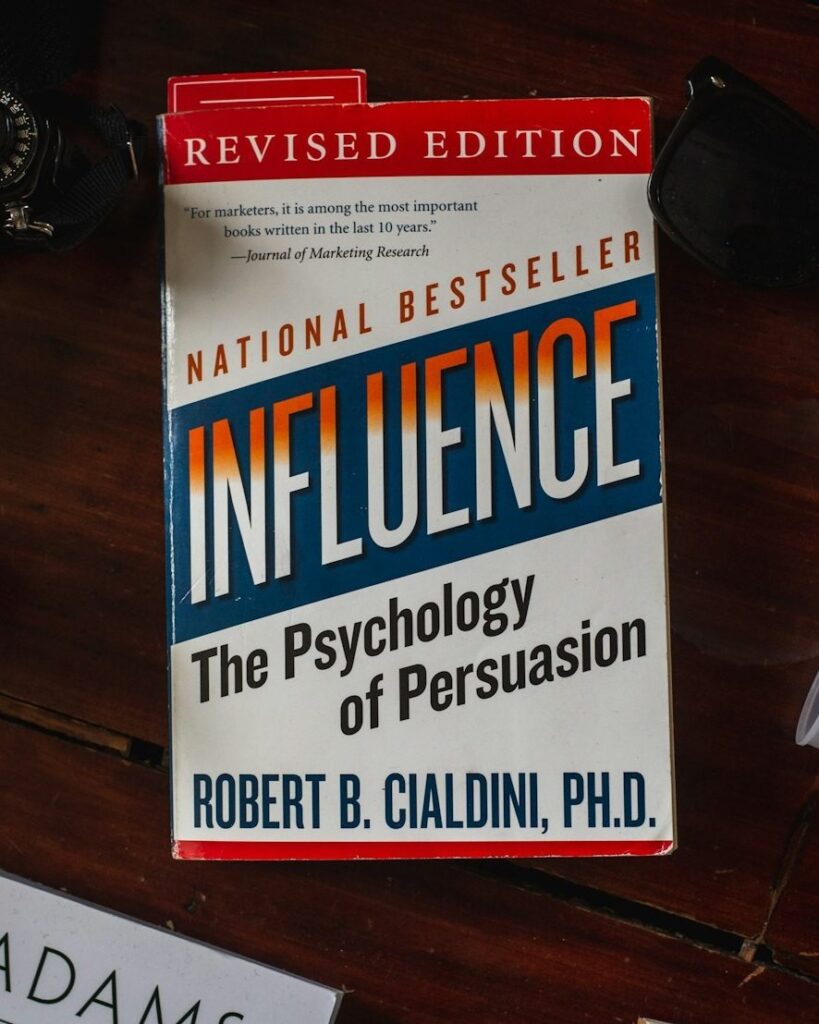
Author: Robert B. Cialdini · Published: 1984 · Genre: Psychology, Persuasion
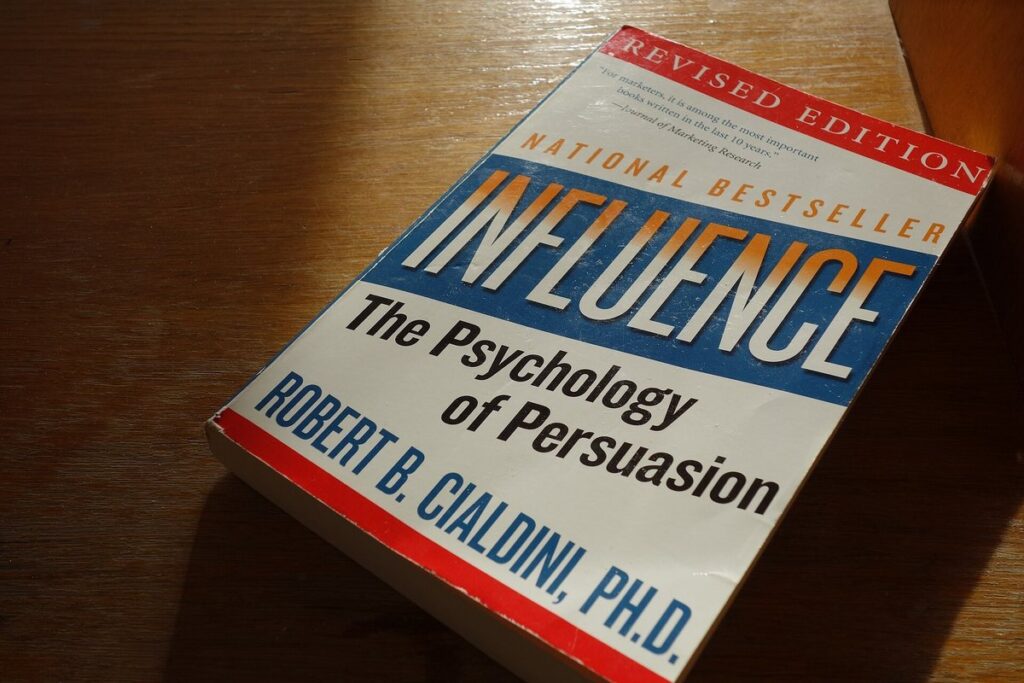
Influence identifies six mental shortcuts that make people comply with requests and shows how professionals exploit them. Four decades on, it is still the best book on persuasion for general readers: vivid, well organized and useful as both a defense manual and a marketing text. A few of its examples have not aged well, but the framework has.
The big idea
Cialdini, a social psychologist at Arizona State University, argues that we run on automatic rules because we can’t analyze every decision from scratch. He compares us to a mother turkey who will care for anything that makes the right chick sound. Those rules usually serve us well, which is exactly why they can be hijacked. He names six triggers:
- Reciprocation: we feel obliged to repay gifts and favors.
- Commitment and consistency: once we take a stand, we act to stay consistent with it.
- Social proof: we copy what others do, especially when unsure.
- Liking: we say yes to people we like.
- Authority: we defer to experts and the symbols of expertise.
- Scarcity: we want what is rare or disappearing.
The expanded edition published in 2021 adds a seventh principle, unity: the pull of a shared identity.
What works
The research method is unusual and pays off. Alongside lab studies, Cialdini went undercover in sales, fundraising and advertising training programs, so the book shows how these tactics are actually used on real customers, not just on students in a lab.
The examples stick. Hare Krishna members hand travelers a flower as a gift, then ask for a donation. A jewelry store finally sells a slow-moving batch of turquoise after an employee mistakenly doubles the price, because buyers read a high price as a sign of quality. A Boy Scout gets Cialdini to buy chocolate bars he doesn’t want by first asking him to buy pricier circus tickets, then retreating to the smaller request. In the commitment chapter, Chinese captors in the Korean War get American prisoners to make small, mild criticisms of their country, then build on each one. Once you know the pattern, you see it everywhere, from car dealerships to free samples at the supermarket.
Each chapter ends with advice on how to say no. That turns the book from a catalog of tricks into something practical: spot the trigger, then ask whether the request makes sense on its merits.
The prose is plain and often funny, and Cialdini freely admits he has long been an easy mark himself. That makes the book far more readable than most social psychology.
What doesn’t
Some of the evidence has weakened. The social proof chapter leans on the 1964 murder of Kitty Genovese in New York and the story of 38 neighbors who saw or heard the attack and did nothing. Later reporting showed that account was badly exaggerated: far fewer people understood what was happening, and some did try to help. The bystander research built around the case still stands, but the headline example is shaky.
Like much social psychology from that era, some of the cited experiments were small and have not all been retested under modern standards. The book sounds more certain than the field now is.
There is also an uncomfortable irony. A book meant partly as self-defense became a standard text for marketers, and its principles now power plenty of manipulative online design, such as countdown timers and warnings that only a few items are left.
Finally, the structure gets repetitive. Each principle receives a similar treatment of studies, anecdotes and defenses, and by the last chapters the pattern feels predictable.
Who should read it
Anyone who buys things, which is everyone, but especially people who work in sales, marketing, negotiation or fundraising. Pick the newest edition for the unity chapter and updated examples.
Rating: 4.5/5
Photo credits — Featured image: Photo by Louis Hansel on Unsplash. In-article photo: Photo by Jakub Šafránek via Wikimedia Commons, CC BY-SA 3.0, cropped.
