

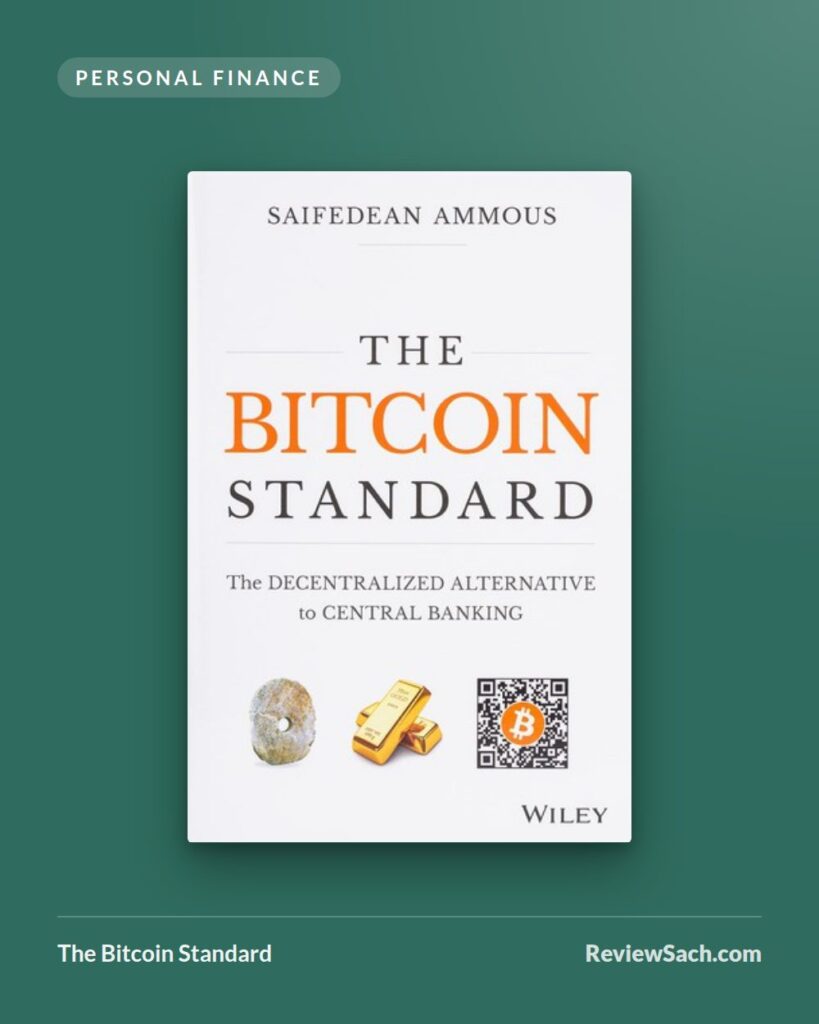
Author: Saifedean Ammous · Published: 2018 · Genre: Economics, Cryptocurrency
The Bitcoin Standard is the best-known book-length case for bitcoin as sound money, and its biggest strength is a lively history of why some things become money and others don’t. Its biggest weakness is that it is a polemic: it waves away mainstream economics and blames government money for problems from modern art to junk food. It is worth reading if you want to understand the ideas behind much bitcoin advocacy, ideally alongside its critics.

The big idea
Ammous, an economist in the Austrian school tradition of Ludwig von Mises and Friedrich Hayek, argues that good money must be hard to produce. His key measure is the stock-to-flow ratio: how large the existing supply is compared with new production. Seashells, glass beads and the giant Rai stones of Yap all worked as money until someone found a cheaper way to make more of them. Gold won out because its existing stock dwarfs each year’s new supply.
Government-issued money, he argues, is easy money. Central banks can expand its supply, which he says erodes savings, distorts interest rates, encourages debt and finances war. Living with such money makes societies more focused on the present, or in economic terms raises their time preference.
Bitcoin is his answer. Its supply is capped at 21 million coins, released on a fixed schedule that no government or central bank can change. He presents it as digital gold: a store of value that can’t be debased, moves easily across borders and doesn’t depend on trusting an institution.
What’s great
- The money history. The chapters on primitive money, the debasement of Roman coinage and the classical gold standard are vivid and give readers a useful framework, even if they reject his conclusions.
- Clarity on bitcoin’s design. Jim Epstein, reviewing it for Reason, praised its clear account of the fixed supply and mining incentives, and non-technical readers can follow it.
- A coherent argument. Whatever you think of it, the book states the store-of-value case more systematically than most writing on the subject.
The controversy
Most economists reject the book’s central premises. The gold-standard era saw deflation and frequent banking panics, and economic historians such as Barry Eichengreen have argued that the gold standard helped spread the Great Depression. When the University of Chicago’s IGM Forum asked leading economists in 2012 whether a return to gold would improve price stability and employment for the average American, none agreed. Critics such as George Selgin argue that a money supply unable to respond to demand forces painful falls in prices and wages during downturns.
Reviewers in Reason and the Cato Journal, both free-market outlets, faulted the book for pinning society’s cultural ills on government money. Ammous extends that argument to art, architecture and food with little evidence.
Bitcoin’s record since 2018 cuts both ways. Its price has gone on to new highs, which supporters cite as vindication, but it lost more than three-quarters of its value from peak to trough in both the 2018 and 2022 downturns, which critics see as incompatible with a stable store of value. Nassim Taleb, who wrote the book’s foreword, published a paper in 2021 arguing that bitcoin had failed as a currency and as a hedge. The book does address energy use and bitcoin’s limited capacity for everyday payments, but mostly by arguing they don’t matter, which skeptics find unconvincing.
Who should read it
Read it if you want to understand the intellectual case behind bitcoin advocacy or the Austrian view of money, and pair it with a mainstream monetary history. This review describes the book’s arguments and is not investment advice.
Rating: 2.5/5
Image credits — Featured image: cover image via Open Library; cover design © the publisher, shown for review purposes. In-article images: Photo by Bastian Riccardi on Pexels.
