

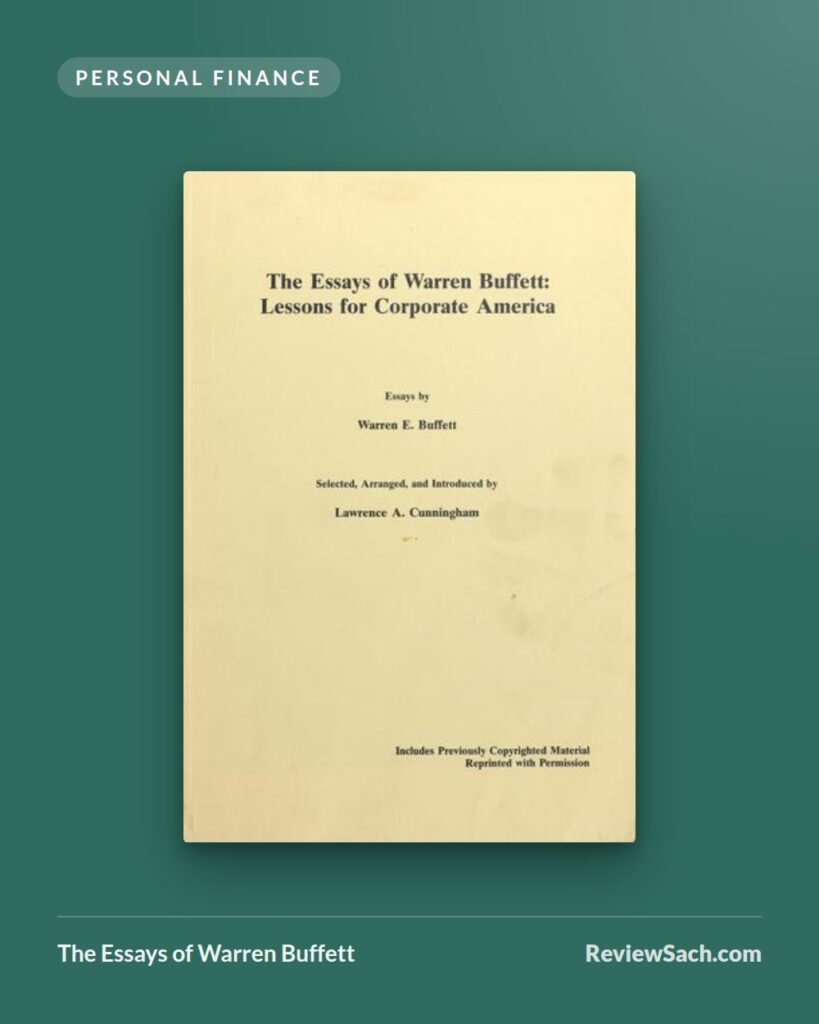
Author: Warren Buffett (edited by Lawrence A. Cunningham) · Published: 1997 · Genre: Investing, Business
The Essays of Warren Buffett is the best way to read Buffett in his own words. Lawrence Cunningham rearranges decades of Berkshire Hathaway shareholder letters by theme, turning them into a coherent course on investing, management and business ethics. Serious investors and business owners should own it; beginners may find it slow going.
What it’s about
Cunningham, a law professor, assembled the book after a 1996 symposium on Buffett’s letters at Cardozo School of Law. Instead of reading the letters year by year, you get chapters on corporate governance, finance and investing, investment alternatives, common stock, mergers and acquisitions, valuation and accounting, and taxes. The collection has been updated several times as new letters appeared. Along the way Buffett explains Berkshire’s unusual choices, such as paying no regular dividend and refusing to split its original class of shares, and why he thinks they serve long-term owners.
The letters were written for Berkshire’s shareholders, but Buffett always wrote them for an intelligent non-specialist, often picturing a relative who wasn’t in finance. That is why they read so well. Cunningham adds an introduction but otherwise keeps out of the way, so the voice throughout is Buffett’s own: dry, folksy and precise.
What works
- Investing philosophy in plain English. Buffett explains intrinsic value, margin of safety and Benjamin Graham’s parable of Mr. Market, the moody business partner whose daily price offers you can take or ignore. His point that market swings are an opportunity rather than a threat is clearer here than in most textbooks.
- Owner thinking. Ideas such as owner earnings, look-through earnings and the circle of competence teach readers to see a share as part of a real business, not a ticker symbol.
- Governance and incentives. Buffett’s critiques of badly designed stock options, empire-building acquisitions and managers who put themselves before shareholders are sharp and often funny. His explanation of how issuing shares to pay for an acquisition can quietly hurt existing owners is a small masterclass.
- Insurance float. The essays explain how Berkshire invests the premiums it holds before claims are paid, a cheap source of funding that is central to its growth and widely misunderstood.
- Candour about mistakes. Buffett is open about his own errors, including businesses he overpaid for or should never have bought, and treats them as lessons rather than burying them. That honesty is rare in corporate writing and makes his successes more credible.
What doesn’t
Rearranging by theme removes context. A passage written during one market boom sits beside one written during a later crisis, and it isn’t always obvious what conditions Buffett was responding to. There is also repetition, because he returned to favourite ideas across decades.
Some chapters, particularly on accounting and taxes, are technical and specific to Berkshire. Readers without some grounding in financial statements will struggle. It is also Buffett’s own account of his own company, so outside criticism of Berkshire’s decisions is absent by design.
The book also gives no step-by-step method. Buffett has long said that most people are better off simply buying a low-cost index fund, so anyone hoping for a stock-picking formula may be surprised. Reading him can even breed overconfidence: his principles are easy to state and very hard to apply, and few investors have his temperament, patience or access to deals.
Who should read it
Anyone who invests in individual companies, runs a business or sits on a board. Newer investors should start with a simpler guide and come back to this once the basics are in place. It rewards rereading, one chapter at a time.
Rating: 4.5/5
Image credits — Cover image via Open Library. Cover design © the publisher, shown for review purposes.
