

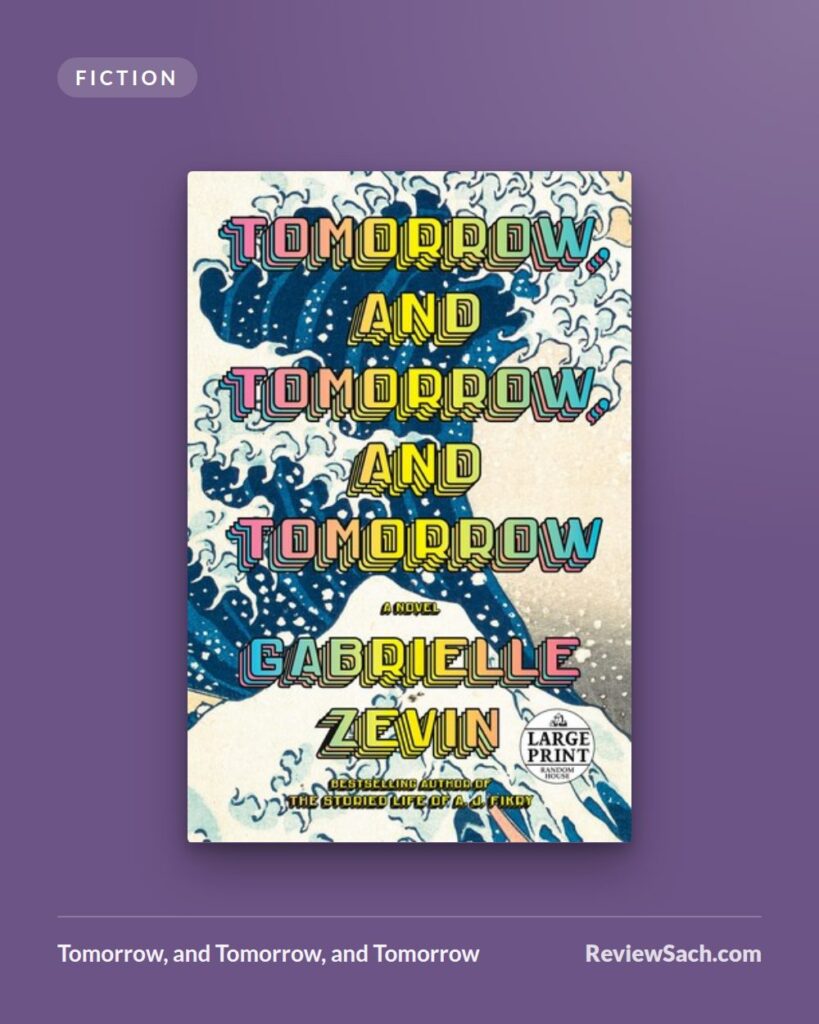
Author: Gabrielle Zevin · Published: 2022 · Genre: Literary Fiction
Tomorrow, and Tomorrow, and Tomorrow is a novel about a creative partnership that outlasts most marriages, told through the video games two friends build together. It’s generous, clever and emotionally sharp, if a little long in the middle. You don’t need to play games to enjoy it, but you do need patience for two people who hurt each other a lot.
What it’s about
Sam Masur and Sadie Green meet as children in a Los Angeles hospital in the 1980s. Sam is recovering from the car crash that killed his mother and crushed his foot; Sadie is there because her sister, Alice, is being treated for leukemia. They bond over video games in the hospital’s game room. Sam is half Korean and partly raised by his grandparents, who run a pizzeria in Koreatown; Sadie comes from a comfortable Jewish family. When Sam learns that Sadie had been logging her visits as community service, the friendship breaks.
Years later they run into each other at a Boston train station, Sam a student at Harvard and Sadie at MIT, and decide to make a game together. Sam’s roommate, Marx Watanabe, an easygoing actor with a gift for managing people, becomes their producer. Their first game, Ichigo, about a child lost at sea, launches a company, Unfair Games, and a relationship that runs through decades of success, failure, jealousy and grief. The title comes from Macbeth’s speech about time, and it doubles as a nod to games, where you can always press restart.
What works
- Games as art. Zevin writes about game design as seriously as other novelists write about painting or music. You understand why a mechanic, a visual style or a borrowed idea matters, and each game the characters make reflects where they are in their lives.
- A friendship that isn’t a romance. The book resists the obvious love story. Sam and Sadie love each other, but their real bond is creative, and the novel is honest about how collaborators compete for credit and attention.
- Sam’s body. Zevin writes about chronic pain with care. Sam’s damaged foot shapes his pride, his secrecy and his love of virtual worlds where his body doesn’t limit him.
- Marx. The quieter third partner is the book’s heart. His kindness is the counterweight to Sam and Sadie’s pride.
- Formal play. A section set inside one of their online worlds is among the most affecting in the book, and it shows how a game can hold feelings its players can’t say aloud.
What doesn’t
The middle drags. Some stretches read like a summary of the characters’ careers rather than scenes. Sadie’s relationship with Dov, her manipulative former professor and a successful game designer, takes up a lot of space and makes its point several times over.
Sam and Sadie can also be exhausting. Their resentments are realistic, but they build over years of silences and misunderstandings that one honest conversation might have fixed. Some readers find this true to life; others find it frustrating.
The plot also leans on a few big dramatic events, including one sudden act of violence, that some readers find tonally jarring in a book otherwise driven by small, human conflicts. The narration also hops between decades and points of view, which occasionally blurs whose story is being told.
Who should read it
Anyone who has built something with a friend, gamer or not, and readers who liked Zevin’s earlier The Storied Life of A. J. Fikry. Readers who grew up in the 1990s will enjoy the period detail, from campus computer labs to the first online worlds. It won the 2022 Goodreads Choice Award for Fiction and was named Amazon’s best book of that year.
Rating: 4/5
Image credits — Cover image via Open Library. Cover design © the publisher, shown for review purposes.
