

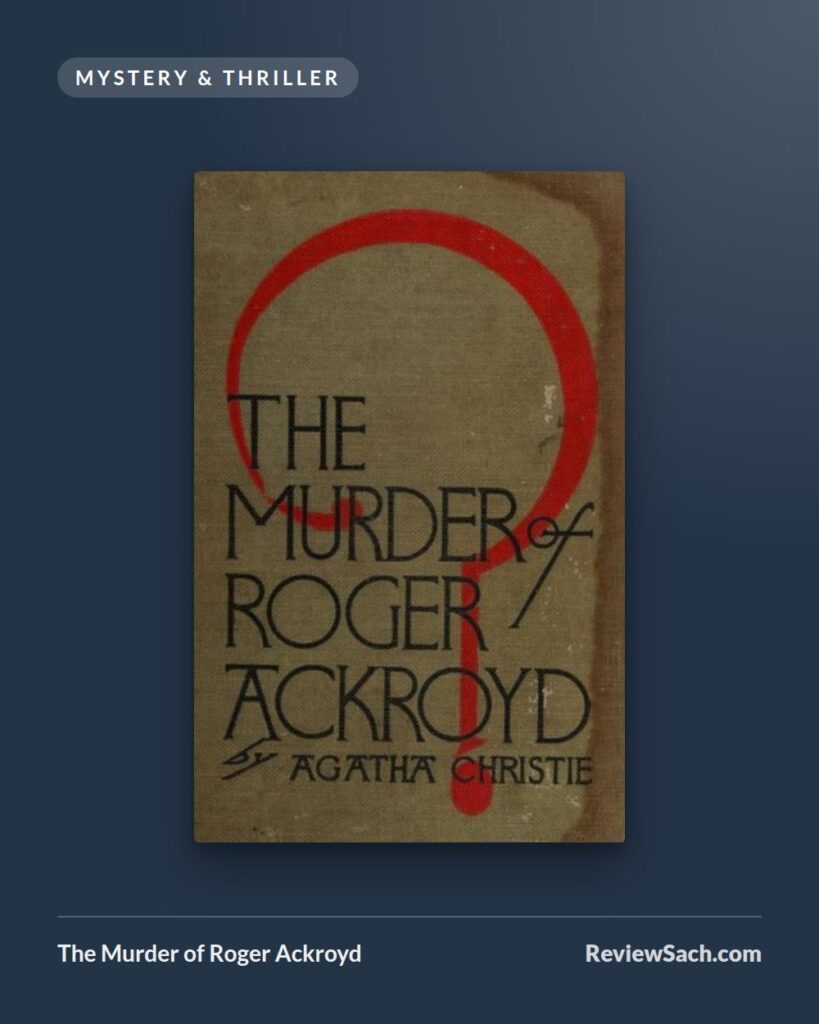
Author: Agatha Christie · Published: 1926 · Genre: Mystery, Classic Crime
The Murder of Roger Ackroyd is the Poirot novel that made Christie’s name, and its solution is still one of the boldest in the genre. The village setting is cosy, the clues are scrupulously placed, and the ending, whether you call it genius or cheating, changed what readers thought a detective story could do. Read it before anyone spoils it for you.
What it’s about The story is narrated by Dr James Sheppard, the doctor in the English village of King’s Abbot, who lives with his sharp-eared, gossip-loving sister, Caroline. A wealthy widow, Mrs Ferrars, dies of an overdose, and the village has long whispered that she poisoned her husband. The next evening, Roger Ackroyd, the local magnate who had hoped to marry her, receives a letter from her that he insists on reading alone. By the end of the night he is dead in his study, stabbed.
Suspicion falls quickly on Ackroyd’s stepson, Ralph Paton, who has vanished. But the house is full of people with secrets: Ackroyd’s niece Flora, his sister-in-law, his secretary, his butler, his housekeeper, a parlourmaid and a big-game hunter staying as a guest. Luckily, a retired foreigner has just moved in next door to the Sheppards to grow vegetable marrows. He is Hercule Poirot, and Flora persuades him to take the case, with Dr Sheppard as his assistant.
What works – Clue placement. Christie hides key facts inside ordinary sentences. On a second reading, almost every chapter contains something you slid straight past. That is the mark of a real puzzle rather than a trick. – Caroline Sheppard. The doctor’s nosy sister is the book’s comic engine and its best character, a village intelligence service in a single person. Christie later suggested that the fun of writing her helped give rise to Miss Marple. – Poirot in retirement. Bored, vain and quietly sly, he is at his best here, needling the local police and coaxing confessions out of people who think they are only chatting. The final gathering of suspects is one of his finest. – Village texture. The gossip networks, the tea tables and the class anxieties of King’s Abbot make the setting feel lived in, and they double as camouflage for the clues.
The controversy Readers and critics argued about the ending from the start. The objection is that Christie broke an unwritten rule of the fair-play detective game and misled the reader in a way that went beyond the usual sleight of hand. Some called it a cheat. Defenders, including Dorothy L. Sayers, replied that Christie never actually lies, and that it is the reader’s job to suspect everybody. The debate never fully ended: in 1998 the French critic Pierre Bayard published a whole book arguing that Poirot got the answer wrong. In 2013, members of the Crime Writers’ Association voted it the best crime novel ever written, which suggests the defenders won. My view: it is fair. Everything you need is on the page.
The book has more ordinary flaws too. The middle section, heavy on timings, alibis and who was where at which minute, drags. The servants are mostly suspects or comic relief, and the class attitudes are firmly of their time. Several of the supporting cast, including Ralph Paton, are thin, and one romantic subplot exists mainly to provide red herrings.
Who should read it Anyone who enjoys puzzle mysteries, and especially readers who are sure they cannot be fooled. Read it cold: skip introductions, blurbs and adaptations until you have finished. Then reread it and watch how it was done. It needs no knowledge of the earlier Poirot books, so it can serve as a first Christie, though And Then There Were None is the easier way in for complete newcomers.
Rating: 4.5/5
Image credits — Cover image via Open Library. Cover design © the publisher, shown for review purposes.
